Area Real Estate News & Market Trends

You’ll find our blog to be a wealth of information, covering everything from local market statistics and home values to community happenings. That’s because we care about the community and want to help you find your place in it. Please reach out if you have any questions at all. We’d love to talk with you!

May 11, 2026

Why Staging Your House Could Pay Off This Spring

Selling your house this season? You’ve probably heard you should stage it before it hits the market. But what does that really mean – and is it worth the effort?

The short answer is “yes,” especially right now.

With more houses for sale this year, you’re likely wondering how to make the most money possible without your house sitting on the market. The answer is staging. It can help your house stand out, bring in stronger offers, and sell faster. As Nadia Evangelou, Principal Economist at the National Association of Realtors (NAR), puts it:

“Staging matters. Preparing the home to be ‘buyer-ready’ attracts more buyers, especially now that inventory has increased.”

Here's what staging actually involves and what it could do for your sale.

What Is Home Staging?

Home staging is the process of preparing your house, so it appeals to as many buyers as possible. That usually means decluttering, deep cleaning, rearranging furniture, and adding simple touches that help each room feel bright, open, and welcoming.

The goal is to help buyers fall in love with the space and picture themselves living there, which makes them more likely to make an offer.

Why Staging Is Worth the Effort

Staged houses tend to perform better on almost every metric that matters when you sell. According to Redfin, staged homes have been shown to sell up to 73% faster than unstaged homes. And they often close in under a month, compared to anywhere from two to three months for vacant ones.

There’s also a strong return on the money you spend.

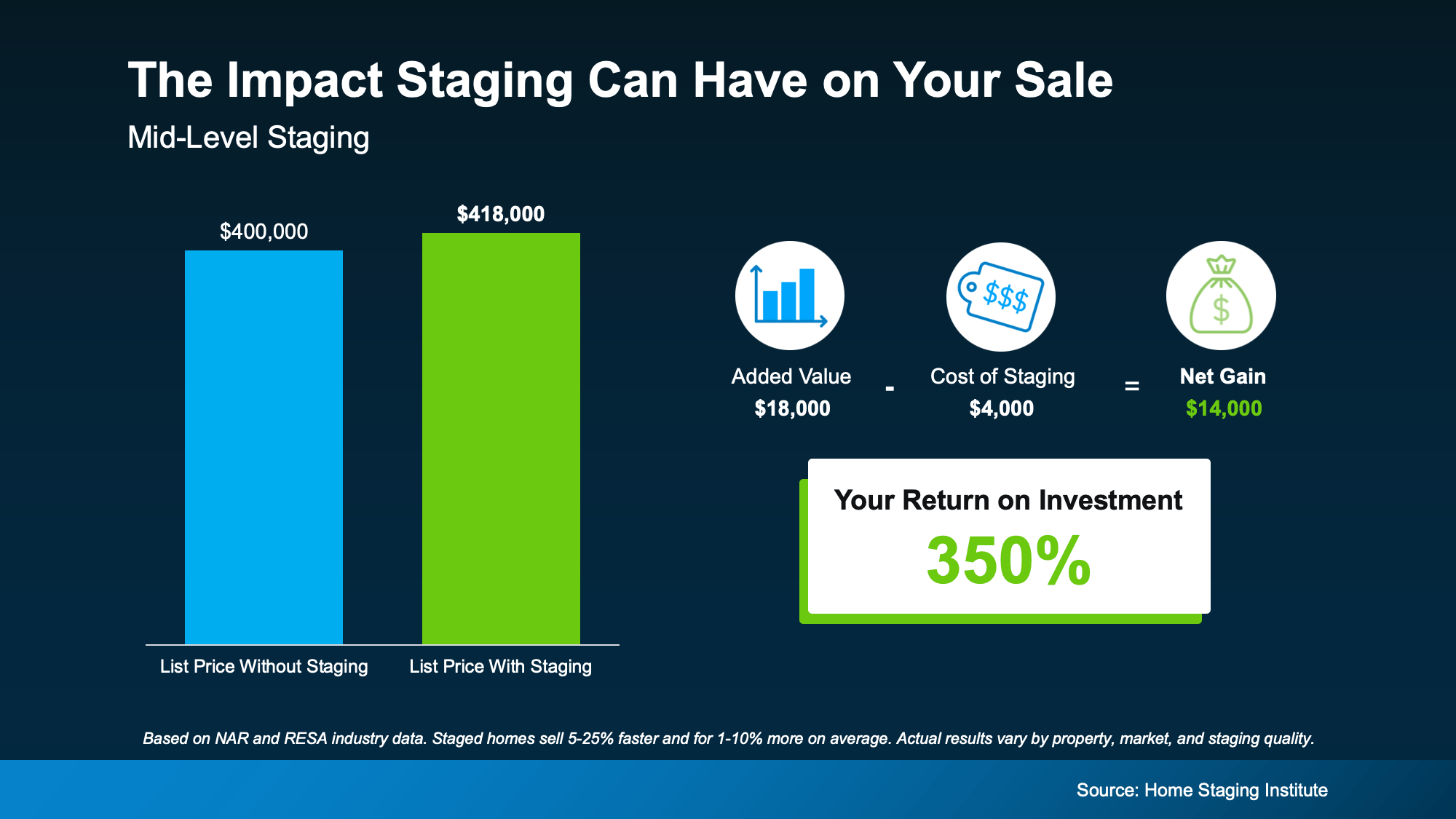
The Home Staging Institute says mid-level staging can deliver a 350% return on investment. On a $400k home, that turns the typical $4k cost into roughly $18k in added value when you sell (see graph below):

a screenshot of a sales reportBy that estimate, that’s an extra potential profit of about $14k – a meaningful boost when you’re trying to maximize what you walk away with at closing.

Your Staging Options

And just in case you’re seeing that $4k upfront investment above and thinking, “I’m not going to spend that,” here’s what you should know.

Staging doesn’t always have to mean hiring a full crew or filling your house with rented furniture. There are a few different paths you can take, depending on your budget and timeline. So, you could spend a lot less and still get a good return. 

Here are a few options:

  • Professional staging. A stager handles everything from layout to décor, often bringing in their own inventory. According to the Home Staging Institute, costs typically range from $500 to $5k or more, depending on the size of your house.
  • Virtual staging. Digital furniture and styling are added to your listing photos, which can be a budget-friendly option for vacant houses.
  • DIY staging. If your budget is tight and your home only needs minor updates, decluttering, deep cleaning, and arranging furniture for flow can still make a real difference.

Your agent can help you figure out which approach fits your house, your market, and your goals.

Agents see what buyers respond to in open houses and showings every week, so they can give you specific, personalized recommendations on what’s worth your time and money (and what isn’t).

That way you can get the most bang for your buck – no matter your budget.

Bottom Line

With more homes for sale right now, making a strong first impression matters. Staging can help your house sell faster and for more – and there's an option for almost every budget.

If you’re getting ready to list, let’s talk about what level of staging makes sense for your house and make a plan for attracting the right buyers.

The information contained, and the opinions expressed, in this article are not intended to be construed as investment advice. Keeping Current Matters, Inc. does not guarantee or warrant the accuracy or completeness of the information or opinions contained herein. Nothing herein should be construed as investment advice. You should always conduct your own research and due diligence and obtain professional advice before making any investment decision. Keeping Current Matters, Inc. will not be liable for any loss or damage caused by your reliance on the information or opinions contained herein.

Posted in Real Estate
May 8, 2026

Selling In Rita Ranch When You Need More Space Or Less

If your Rita Ranch home no longer fits the way you live, you are not alone. Maybe you need an extra bedroom, a better layout, or less upkeep now that life looks different than it did a few years ago. The good news is that Rita Ranch is still an active market, and with the right plan, you can sell smart and move with less stress. Let’s dive in.

Rita Ranch is active, but buyers have options

Rita Ranch is not a panic-sell market right now. In March 2026, Redfin reported a median sale price of $333,975, 70 days on market, and 48 homes sold, while Realtor.com showed 111 homes for sale, a $347,500 median list price, and 47 days on market. Those numbers vary by source, but they point to the same story: buyers are active, inventory exists, and pricing needs to be sharp.

That matters if you are selling because your next home will likely cost more if you are moving up, or require thoughtful comparison if you are downsizing. At the Tucson metro level, MLSSAZ reported a March 2026 median sales price of $359,000. Since Rita Ranch sits slightly below that median, your equity position can look different depending on where you plan to go next.

Why Rita Ranch sellers face regional competition

Your home is not only competing with other Rita Ranch listings. Buyers often compare homes across southeast Tucson, especially in nearby Vail and Sahuarita, where they may find different price points, newer construction, or more upgraded finishes.

In Vail, Realtor.com described the March 2026 market as balanced, with 629 homes for sale, a $425,000 median list price, 65 days on market, and a 100% sale-to-list ratio. In Sahuarita, Realtor.com reported 577 homes for sale, a $375,000 median list price, 68 days on market, and a 99% sale-to-list ratio.

For Rita Ranch sellers, this means buyers may compare your home with similar-priced resale options, newer homes, or homes with a different feature mix. If your home is clean, well-presented, and priced in line with today’s choices, you have a better chance of standing out.

Selling for more space

If you need more space, your sale is only half of the decision. You also need to think about what your next price band looks like and whether moving up now still makes sense for your budget and goals.

Because Rita Ranch pricing is a bit below the broader Tucson median, many move-up sellers look toward areas and neighborhoods with higher list prices. Vail, for example, spans a wide range, from neighborhood medians around $356,950 in Four Seasons and $400,000 in Rancho del Lago to much higher levels in places like New Tucson and Coyote Creek.

That range can be helpful if you want more room, a different lot size, or a newer home. It also means you should estimate your likely sale price carefully before shopping. A realistic look at your current equity can help you decide how much more space is truly comfortable for you.

What move-up buyers want to see

A larger home still needs to feel functional. Buyers are not just shopping for square footage. They are looking for layouts that solve real daily needs, like flexible rooms, storage, updated kitchens, and systems that feel efficient and manageable.

NAR’s 2025 buyer and seller research found that buyers continue to make trade-offs based on function. Even when someone wants a bigger home, they still care about how the space works. If your home already offers a bonus room, a usable den, or a layout that supports home office or guest space, make sure that value is obvious when you list.

Selling for less space

Downsizing in Rita Ranch can work well, but success often comes from how clearly your home shows its function. Today’s buyers are often more open to a smaller home than they were a few years ago, especially if the layout is efficient and the condition feels move-in ready.

According to NAR’s 2025 research, 40% of buyers were willing to accept a smaller home, 33% were willing to accept a smaller or no garage, and 25% were willing to accept smaller room sizes. That is important for downsizers because it shows that buyers do not always need maximum square footage. They need a home that feels practical and easy to live in.

If your goal is less maintenance, lower costs, or a simpler lifestyle, selling now can create options. The key is to position your current home so buyers see comfort, usability, and value right away.

What updates are worth doing first

In Rita Ranch’s price range, first impressions matter. You do not usually need a major remodel to compete well, but you do need to remove distractions and make the home feel cared for.

The best return often comes from minor cosmetic improvements and staging rather than large renovation projects. Realtor.com’s Vail seller guidance notes that paint, fixtures, and landscaping typically offer stronger payoff than major renovations, which do not always return their full cost.

A simple pre-listing plan usually includes:

  • Decluttering rooms and storage areas
  • Neutralizing bold decor or paint choices
  • Fixing visible maintenance issues
  • Refreshing light fixtures or hardware where needed
  • Cleaning up landscaping and entry areas
  • Making key rooms feel open and easy to understand

Why staging matters in Rita Ranch

Staging is not just for luxury listings. In NAR’s 2025 staging report, 83% of buyers’ agents said staging made it easier for buyers to visualize a property as a future home. Another 29% said staging led to a 1% to 10% increase in the dollar value offered.

Nearly half of sellers’ agents also said staging reduced time on market. In a market where buyers can compare Rita Ranch with Vail and Sahuarita, that matters. A home that feels clean, bright, and functional has a better chance of earning attention early.

Should you sell first or buy first?

This is one of the biggest questions for homeowners who need more space or less. The right answer depends on your equity, your comfort with timing, and how much overlap risk you can manage.

Selling first can help you lock in funds and understand your real budget for the next purchase. The trade-off is that you may need temporary housing or a very well-timed next move. Buying first can reduce the pressure of finding your next home quickly, but it may require bridge financing or more financial flexibility.

There is no one-size-fits-all answer. What matters most is making the decision early, before your home hits the market, so your pricing, prep, and timing all support the same plan.

Build your plan before listing

A smoother move usually starts with a few clear steps:

  1. Estimate your likely sale range based on current Rita Ranch conditions.
  2. Review your equity and next-home budget.
  3. Decide whether selling first or buying first fits your finances and stress level.
  4. Prioritize cosmetic prep over major renovation unless a larger issue needs attention.
  5. Launch with pricing that reflects both local and nearby competition.

This kind of planning matters because most sellers are not moving in a vacuum. NAR’s 2025 profile found that the typical seller had owned their home for 11 years, and 91% of sellers used a real estate agent. Sellers also most wanted help with marketing, pricing, and selling within a specific timeframe.

School boundary details should be accurate

For buyers comparing homes in Rita Ranch, school boundary information is often part of the research process. The Vail School District says Rita Ranch neighborhoods are in the Cienega High School attendance boundary, and the district describes Cienega as A-rated and A+ awarded, with AP, dual enrollment, and CTE offerings.

The safest approach as a seller is simple: present school information accurately and encourage buyers to confirm current attendance details directly. Clear, factual information helps buyers compare homes with more confidence.

New construction affects resale decisions

Rita Ranch sellers also need to remember that some buyers are considering new construction nearby. NAR reported that the share of new-home purchases rose to 16%, and buyers choosing new construction often wanted to avoid renovations or major repairs and have the option to customize design features.

That does not mean a resale home cannot compete. It means your home should show its advantages clearly, whether that is established landscaping, a practical layout, a better value, or a move-in-ready presentation. If you are selling in Rita Ranch, your resale strategy should account for the fact that some buyers will compare your home with newer alternatives in Vail or Sahuarita.

The bottom line for Rita Ranch sellers

If you need more space or less, this is still a workable time to sell in Rita Ranch. The market is active, but buyers have choices, which makes pricing, presentation, and planning more important than ever.

Whether you are moving up, downsizing, or just trying to make the next step feel manageable, a thoughtful strategy can protect your time and your equity. If you want local guidance on timing, pricing, and what buyers are comparing across southeast Tucson, Debbie G. Backus can help you create a plan that fits your next move.

FAQs

Is Rita Ranch still competitive enough to sell now?

  • Yes. March 2026 data shows an active market with homes selling, but buyers also have more choices, so pricing and presentation matter.

Should Rita Ranch homeowners sell first or buy first?

  • It depends on your equity, finances, and tolerance for timing risk. Selling first can secure funds, while buying first may reduce moving pressure but can require bridge financing.

Which Rita Ranch updates are worth doing before listing?

  • Minor cosmetic updates, decluttering, visible repairs, landscaping cleanup, and staging usually offer better return than major renovations.

How does Rita Ranch compare with Vail and Sahuarita for sellers?

  • Rita Ranch competes with both areas because buyers often cross-shop nearby homes by price, condition, and features. Vail and Sahuarita also offer broader inventory and newer-home options.

Do school boundaries matter when selling a Rita Ranch home?

  • They can matter to buyers researching the area, so it is helpful to provide accurate, factual information and encourage buyers to verify current attendance details directly.

Posted in Real Estate
May 5, 2026

4 Ways To Give Your Offer an Edge This Spring

Looking to buy a home this season? Here's what you should know. 

Buyers have more leverage today than they’ve had in years. There are more homes to choose from and, in many areas, sellers are more open to negotiation. 

But that doesn’t mean competition is gone completely. These days, it varies a lot depending on where you’re hoping to move. 

If you’re buying in a popular neighborhood, or in a market where there aren’t many homes for sale, you may still find yourself competing with another buyer.

And that’s especially true in the Spring. Here's how to stay one step ahead of any competition this season.

Why Your Best Offer Still Matters This Spring

According to experts at Zillow and Realtor.com, Spring is one of the busiest times of year to buy a home.

That’s because many buyers want to move now so they can settle in before the next school year. And when more buyers enter the market, competition naturally picks up. 

So, depending on where you’re buying, you may still need to move quickly and make a strong offer, even though the market overall has moderated. And that’s especially true if you find a home you really love.

This is what you need to know to make your offer stand out.

1. Lead with a Strong, Realistic Offer

It’s tempting to start low and negotiate up. And in some markets, that strategy can work. But if a home is priced well and getting attention, lowballing could hurt your chances.

Instead, focus on making an offer that reflects your local market. As Bankrate explains:

“There is no magic formula for an optimal home offer. Any offer will be heavily dependent on asking price and local market conditions . . . Your real estate agent will know the local market well and can advise what a competitive — but fair — offer will look like in your area.

The goal is to make an offer that makes sense for you and stands out to the seller.  

2. Have a Plan for Competing Offers

If you’ve fallen in love with a home, it’s important to have a plan in case there’s competition from another buyer. One strategy your agent may discuss with you is an escalation clause, which Investopedia explains like this:  

An escalation clause is a way to automatically escalate your bid by a certain dollar amount, up to a certain ceiling, to compete with other bids.

The key is knowing your budget and sticking to it. You don’t want to lose out over a small difference – and this can help prevent that. But you also don’t want to overpay.

Keep in mind that if the appraisal comes in lower than your offer, you may have to make up the difference out of pocket. Your agent can help you weigh those risks and determine the best approach for your situation.

3. Keep Your Offer Clean

Price matters. But sellers also look closely at your offer’s terms. In some cases, a simpler, cleaner offer can stand out – even if it’s not the highest. As Redfin says:

Sellers tend to want clean, straightforward offers with minimal strings attached. Keep your requests simple and focus on the essentials.

Your agent can help you prioritize what matters most, so you’re not giving up things you need, while still making your offer as appealing as possible.

4. Be Flexible Where You Can

Sometimes, what helps your offer the most is understanding what matters to the seller. NerdWallet explains:

As you prepare an offer, you tend to focus on what the seller has (a house) and what you want (their house). But you’ll gain a competitive edge by viewing the transaction from the seller’s eyes: What does the seller want?”

Does the seller need extra time to move out? Or do they want to move as soon as possible? Your agent can talk with the seller’s agent to find out what matters most. Flexibility here can make a big difference in how your offer is received.

Bottom Line

Today's market may be balancing out, but strong offers still matter – especially during the busy Spring season.

Curious how competitive things are (and what it’ll take to win) in our market? Let’s talk.

The information contained, and the opinions expressed, in this article are not intended to be construed as investment advice. Keeping Current Matters, Inc. does not guarantee or warrant the accuracy or completeness of the information or opinions contained herein. Nothing herein should be construed as investment advice. You should always conduct your own research and due diligence and obtain professional advice before making any investment decision. Keeping Current Matters, Inc. will not be liable for any loss or damage caused by your reliance on the information or opinions contained herein.

Posted in Real Estate
May 2, 2026

Think You Have To Put 20% Down? Most First-Time Homebuyers Don’t.

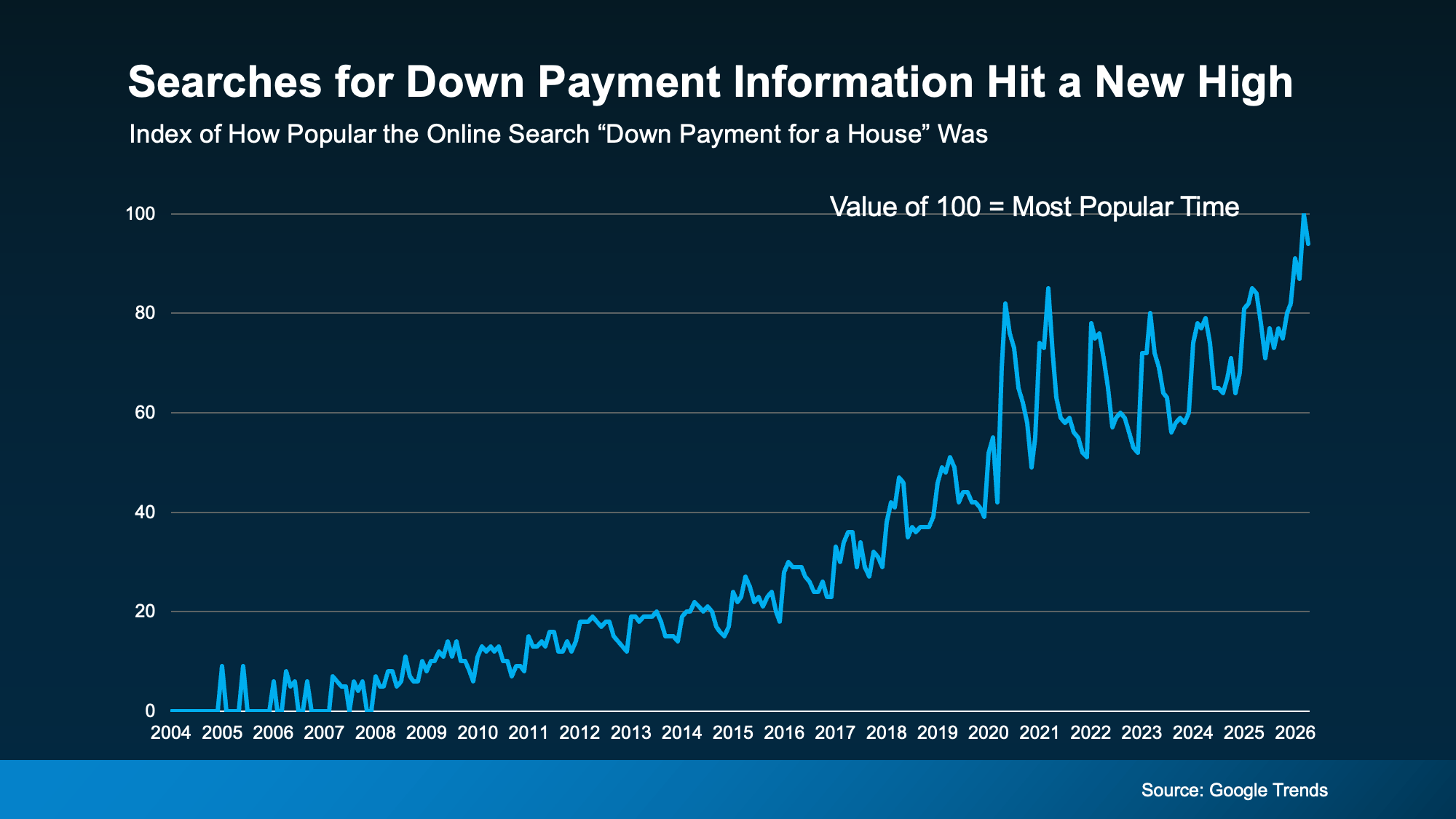
According to Google Trends, online searches for down payment information recently hit an all-time high. And that’s a clear sign more buyers are trying to figure out what they really need to save before making a move (see graph below):

a graph of a line graphIf you’re wondering the same thing, you can always turn to the internet for answers. But a lot of the time, it’s better to ask a local expert. Because here’s what a pro would tell you.

The 20% Down Payment Myth

The idea that you need 20% down to buy a home is one of the biggest misconceptions around the homebuying process. And the data debunks the myth.

While there are benefits to putting that much money down, most first-time buyers put down far less.

Here’s why. Unless it’s stated by your lender, you typically don’t have to have a 20% down payment. There are even some loan options designed to help you get into a home with a much smaller upfront cost. As the Mortgage Reports explains:

“The amount you need to put down will depend on a variety of factors, including the loan type and your financial goals. If you don’t have a large down payment saved up, don’t worry—there are plenty of options available, and you don’t need to put down the traditional 20% . . . many homebuyers are able to secure a home with as little as 3% or even no down payment at all . . .

For example, FHA loans allow down payments as low as 3.5%, while VA and USDA loans offer zero down payment options for qualified applicants, like Veterans.

And those options are just one reason so many first-time buyers are able to buy without a 20% down payment.

What Buyers Are Actually Putting Down

So, if buyers aren’t doing 20%, how much do they actually put down?

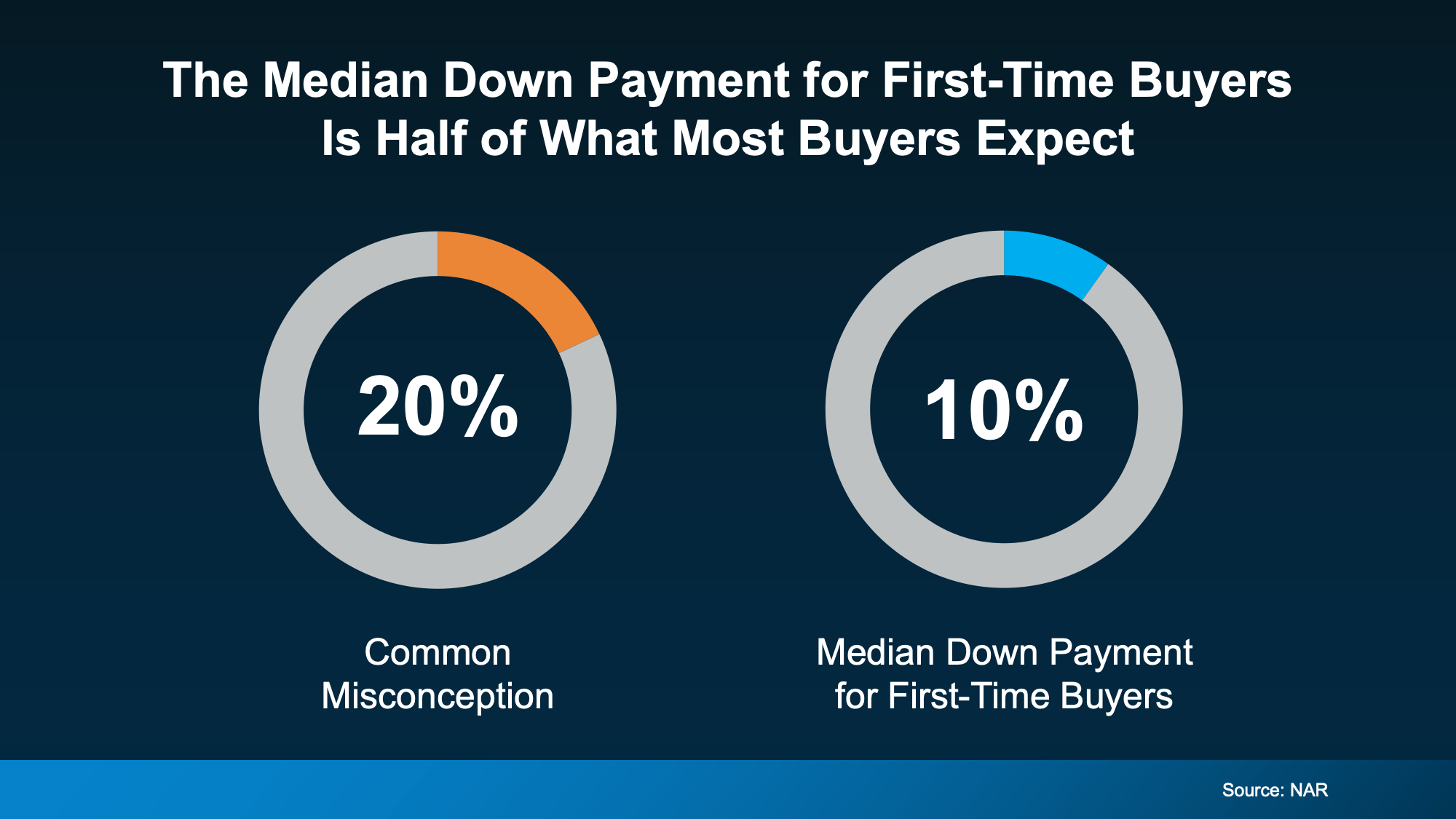
According to the National Association of Realtors (NAR), the median down payment for first-time homebuyers is only 10%. That’s half of what you probably expected.

a diagram of a pie chartThat means if you’re aiming to save 20% because you think you have to, you may be setting a timeline that’s longer than necessary.  

And here’s some more good news. It’s not only that you may be able to buy with less money down than you thought, but there are also options to help you get to your down payment goal even faster.

Why You Should Look into Down Payment Assistance Programs

There are a lot of programs designed to help you save for a down payment – and they can make a big difference in how fast you hit your savings target. Unfortunately, buyers don’t realize how many there are, or that they may qualify for help.

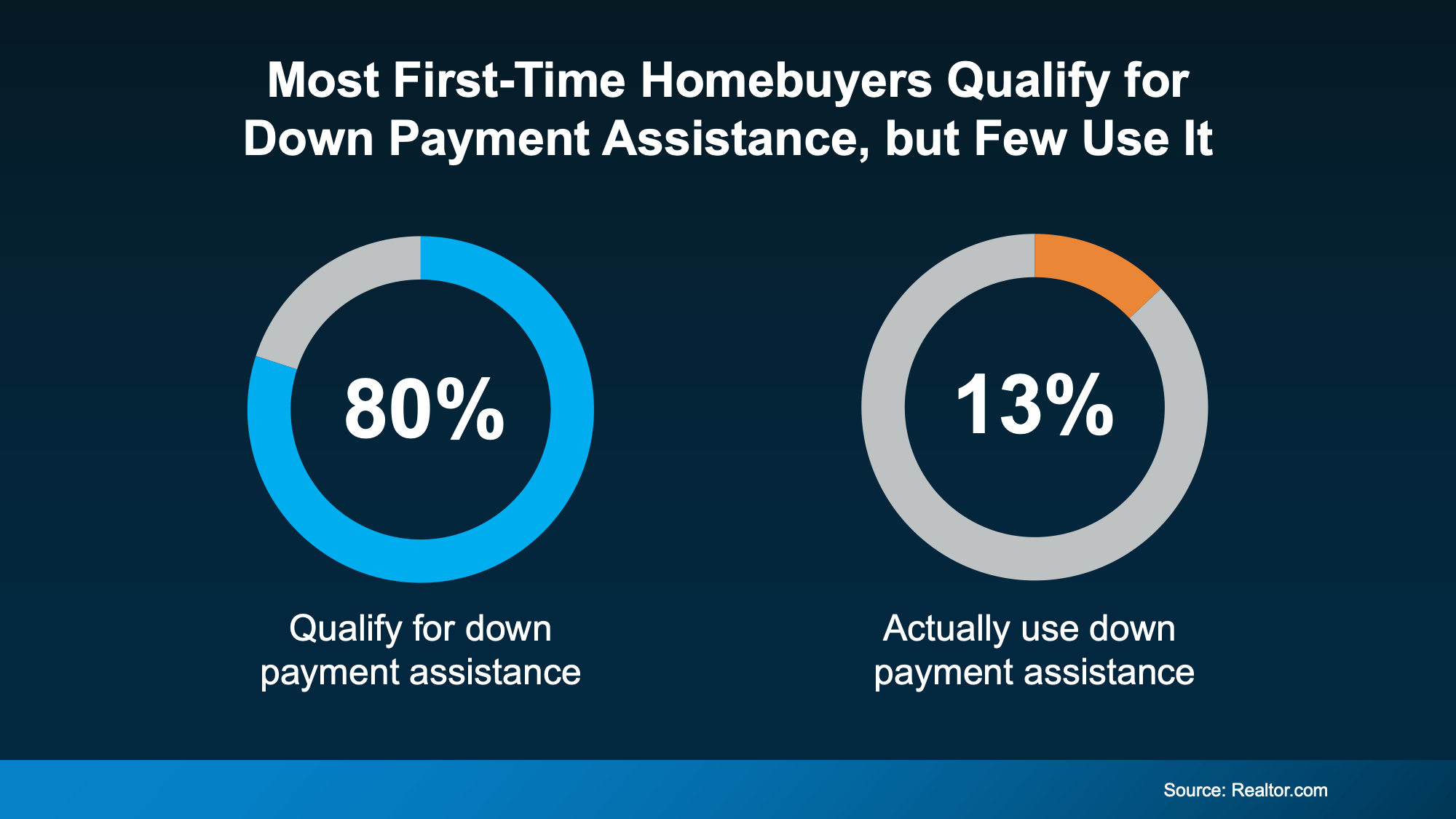
Research from Realtor.com shows almost 80% of first-time homebuyers qualify for down payment assistance (DPA), but only 13% actually use it (see chart below)

a blue and orange pie chartAnd that’s another big miss holding would-be buyers like you back.

In the U.S., there are over 2,600 homeownership programs available, many offering significant financial support. As Down Payment Resource shares:

With an average benefit of $18,000, down payment assistance (DPA) remains one of the most essential tools for addressing the nation’s affordability challenges. Programs continue to expand in scope, serving a broader range of incomes, property types and borrower needs, including first-generation, military and repeat buyers.

Imagine how much further your savings could go with an extra $18,000 you can use to buy. In some cases, you may even be able to stack multiple programs, giving what you’ve saved an even bigger boost.

Bottom Line

The simple truth is: most first-time buyers don’t put 20% down. And if you’ve been waiting to buy until you have that saved, you may be setting a timeline that’s longer than necessary.

To find out what you really need to save and if you qualify for any help, connect with a trusted lender who can walk you through your options. You may be able to buy sooner than you thought.

The information contained, and the opinions expressed, in this article are not intended to be construed as investment advice. Keeping Current Matters, Inc. does not guarantee or warrant the accuracy or completeness of the information or opinions contained herein. Nothing herein should be construed as investment advice. You should always conduct your own research and due diligence and obtain professional advice before making any investment decision. Keeping Current Matters, Inc. will not be liable for any loss or damage caused by your reliance on the information or opinions contained herein.

Posted in Real Estate
April 29, 2026

Thinking About Selling Your Coyote Creek Lot Or Custom Home? Read This

If you are thinking about selling in Coyote Creek, you are not selling a typical house or a generic piece of land. You are selling a property inside a custom-home community where lot layout, design rules, privacy, and view protection can shape buyer interest just as much as square footage or price. That can feel like a lot to sort through, but it also creates an opportunity to market your property more strategically. Let’s dive in.

Why Coyote Creek Sells Differently

Coyote Creek is a master-planned custom-home community in the Rincon Valley next to Saguaro National Park, with 395 acre-plus homesites across 1,000 acres and a minimum lot size of 1.15 acres, with many lots larger than 1.70 acres. The community is also defined by a one-story height limitation, which helps preserve a low-profile look, privacy, and views. You can see these community details on the Coyote Creek community website.

That matters because buyers are not just comparing your property to a standard resale in a nearby neighborhood. They are evaluating how your lot or home fits into a regulated custom-building environment with active HOA oversight, recorded rules, and design standards. The Coyote Creek HOA documents page shows the community’s governing documents, including CC&Rs and design guidelines that buyers often want to review early.

Selling a Coyote Creek Lot

Buyers want buildability

When you sell a vacant lot in Coyote Creek, buyers are usually studying what they can actually build, not just where the lot sits. According to the 2023 Coyote Creek Design Guidelines, homes, garages, pools, walls, and other improvements generally must stay within the approved building envelope.

That building envelope exists to help protect view corridors and privacy. So if your lot has a strong envelope, useful orientation, and a layout that supports a well-placed custom home, those details should be part of the marketing story. A buyer is not just buying acreage. They are buying a specific path to a future home.

Topography affects value

In Coyote Creek, topography is not a side note. The design guidelines say site development should minimize disturbance to natural features, and mass grading to create a building pad is prohibited.

That means slope, drainage, washes, and rock outcroppings can directly affect what a buyer can build and how the finished home will live on the land. A lot with a clear understanding of these site conditions can feel more straightforward to a buyer than one with unanswered questions.

Utility and access details matter

Vacant-land buyers tend to ask practical questions quickly. The design guidelines reference site plans that show topography, utilities, septic placement, drainage, driveways, and underground utility runs.

The Arizona Department of Real Estate buyer checklist also tells land buyers to review the Public Report, ask about water supply and legal access, review zoning maps, and verify builders through the Arizona Registrar of Contractors. If you can present organized lot information upfront, you can reduce friction and help serious buyers move forward with confidence.

Equestrian designation can expand interest

Some Coyote Creek lots have a separate appeal because horses are allowed only on designated lots. The design guidelines note that horse-designated lots may also have added site-disturbance allowances for corrals and related structures.

If your lot has that designation, it should not be buried in the fine print. It may attract buyers looking for space, flexibility, and a property that supports an equestrian or hobby-farm lifestyle within the community rules.

Selling a Coyote Creek Custom Home

Buyers look beyond finishes

If you are selling a completed custom home, buyers are often looking at more than countertops, flooring, and paint colors. In Coyote Creek, they may also pay close attention to how the home fits the lot, how the outdoor areas were planned, and whether the overall design feels cohesive.

The design guidelines require exterior elements to be considered together, including roof materials, windows, lighting, courtyards, walls, gates, garages, landscaping, pools, and hardscape. That means architectural coherence can add to the value buyers perceive when they walk the property.

Community standards shape expectations

Coyote Creek’s design rules help define what buyers expect in the neighborhood. The guidelines require at least 2,300 square feet of heated and cooled living area, a minimum two-car garage, and no two-story homes. They also limit building height, with most of the structure capped at 17 feet over ANGE and a smaller portion allowed up to 20 feet.

For sellers, these standards help explain why Coyote Creek homes often attract buyers who value low-profile custom architecture, privacy, and a strong relationship between house and site. Your home is part of that larger neighborhood identity.

Site finish and compliance matter

A custom home tends to show better when the property feels complete. The design guidelines require utilities to be concealed or buried, solar equipment to be screened and approved, and trash containers to be hidden from view. They also prohibit storage sheds and require landscaping and restoration on developed lots.

Buyers notice when a property feels finished rather than in transition. Clean site work, thoughtful landscaping, and organized exterior spaces can support a stronger first impression.

Documentation builds trust

In a custom-home sale, paperwork can matter almost as much as presentation. The guidelines describe pre-construction inspections, progress inspections, and a final inspection before move-in.

That is why organized records can be a real advantage. If you have approvals, permits, plans, and related documentation available, buyers may feel more comfortable that the home was built and completed in line with the community process.

Pricing in a Balanced Market

Broad market trends suggest that pricing strategy still matters. Redfin’s Vail housing market data shows a median sale price of $400,000 in March 2026 and a median of 134 days on market. The research also notes that Pima County was described as a balanced market, with homes selling for about 1.18% below asking on average in February 2026.

Those figures are only directional for Coyote Creek, because this community is much more site-specific than a typical suburban neighborhood. A Coyote Creek property should be priced around its own characteristics, such as building envelope, orientation, privacy, views, topography, drainage, utility readiness, equestrian designation, and the quality of any existing improvements.

What Sellers Should Prepare

For vacant lots

If you are selling a lot, document prep can make your listing stronger and easier to understand. Helpful items may include:

  • Recorded plat
  • Survey or topography map
  • CC&Rs
  • Current design guidelines
  • DRC correspondence
  • Utility information
  • Septic information
  • Approved plans or permits, if available
  • Photos that clearly show views, access, and the building area

Arizona buyers of land are often reviewing more than photos. They want clarity on access, utilities, HOA rules, and future obligations, which is why the state buyer checklist is so relevant here.

If the Arizona REALTORS® vacant-land purchase contract is used, sellers must also deliver a completed Vacant Land/Lot Seller’s Property Disclosure Statement within five days after contract acceptance. Knowing that timeline in advance can help keep your transaction on track.

For custom homes

If you are selling a completed home, gather both property and project records before the listing goes live. That may include:

  • Approved plans
  • Permits
  • HOA approvals
  • As-built information
  • Landscape or restoration documentation
  • Utility and solar details
  • Any records tied to inspections or completed site work

The goal is simple: make it easy for a buyer to understand what was built, how it fits the site, and how it aligns with community requirements.

How Better Marketing Reduces Friction

In Coyote Creek, strong marketing should explain the site, not just advertise the property. For a lot, that means showing what can be built, where it can sit, how the lot handles drainage and access, and whether there are builder relationships or approvals already in place. For a home, it means showing how the architecture, site planning, and finish work come together.

This is where local, lot-level knowledge matters. In a custom-home community, buyers often need more context before they feel ready to act. Clear answers can make a property feel more valuable because they reduce uncertainty.

If you are preparing to sell your Coyote Creek lot or custom home, working with a brokerage that understands the community’s rules, lot dynamics, and buyer questions can make the process more efficient and more strategic. When you are ready for tailored guidance, connect with Debbie G. Backus for a thoughtful, local approach to marketing your property.

FAQs

What makes selling a Coyote Creek lot different from selling a typical vacant lot?

  • A Coyote Creek lot is part of a regulated custom-home community, so buyers often focus on buildability, the approved building envelope, topography, utilities, drainage, access, and HOA requirements.

What documents should you gather before selling a Coyote Creek lot?

  • Useful documents can include the recorded plat, survey or topo map, CC&Rs, design guidelines, DRC correspondence, utility and septic information, approved plans or permits, and photos showing views and the building area.

What do buyers look for when buying a custom home in Coyote Creek?

  • Buyers often evaluate how the home fits the lot, whether the design feels cohesive, how complete the site work is, and whether approvals, permits, and related documentation are organized.

How should you price a Coyote Creek lot or home?

  • Pricing should reflect property-specific factors such as privacy, view protection, orientation, usable building envelope, drainage, utility readiness, equestrian designation, and the quality of existing improvements.

Do equestrian lots in Coyote Creek need to be marketed differently?

  • Yes. If a lot is designated for horses, that can be a meaningful value driver and should be highlighted clearly because horses are allowed only on designated lots under the community guidelines.
Posted in Real Estate
April 26, 2026

The 10 Best Markets for First-Time Buyers This Spring

For a while, buying your first home hasn’t just felt hard. It may have felt out of reach.

Not because you weren’t ready.

Not because you weren’t trying.

But because every time you ran the numbers, they didn’t work.

That’s why so many first-time buyers stepped back.

But after years of sitting on the outside looking in, this Spring could give buyers like you an opening again – especially in some markets.

Metros Where Buyers May Have an Easier Time Breaking into the Market 

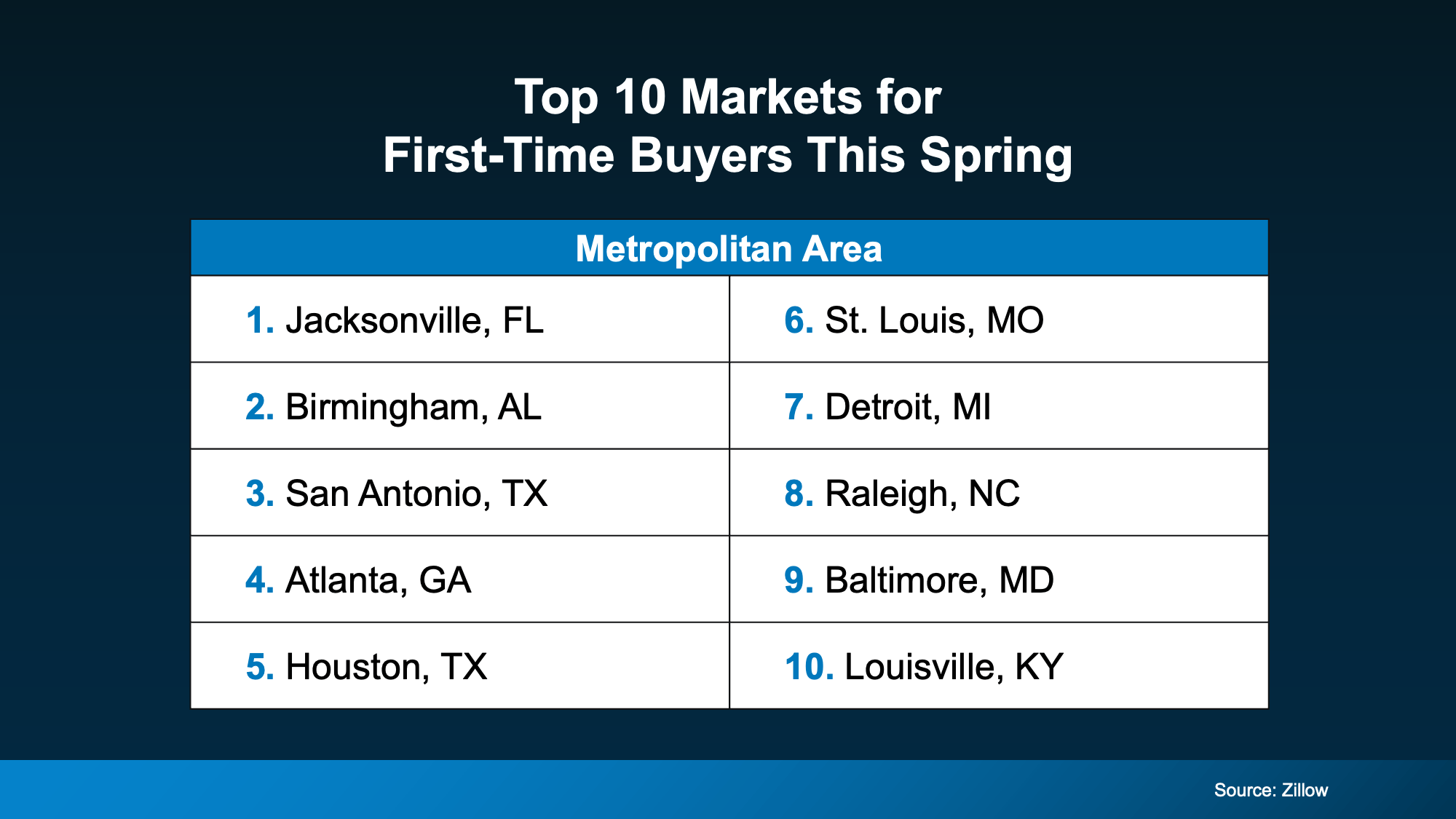
Zillow just released a list of the top 50 metros for first-time buyers this Spring. And here’s a quick snapshot of the top 10 (see chart below): 

a table with white text and black text

According to Zillow, in these top-ranked markets, median-income households can afford 68% of all homes for sale. Let that sink in.

Not long ago, it felt like you could barely afford anything.

Now, you may actually have some options again.

That doesn’t mean every home is suddenly going to fit your budget. But it does mean the door that felt closed for so many buyers is starting to crack back open. And in a number of cities, first-time buyers may finally be getting a shot at buying.

Why This Is Starting To Open Up

These cities are rising to the top not because of any one big change, but from a few smaller ones finally lining up. As Orphe Divounguy, Senior Economist at Zillow, explains:

First-time buyers are finally seeing some light at the end of the tunnel. Affordability is still a challenge, but rising incomes, stabilizing prices and improving inventory are creating real opportunities in parts of the country. In the strongest markets for first-time buyers, they'll find more choices, less competition and a clearer path to homeownership than they've had in years.”

Basically, three big things are working in your favor:

  • More homes are hitting the market. Realtor.com says inventory is up 8.1% compared to last year. That gives you more choices, less pressure, and more chances to find a place that fits your budget.

  • Price growth is moderating, so homes aren’t moving further out of reach as quickly. Some may even be falling back within your target price point.

  • Incomes are rising. If you make more money, that can offset some of the affordability challenges too.

And even though mortgage rates have been higher lately, that combination can still make a difference. As Mark Fleming, Chief Economist at First American, explains:

“Income growth has outpaced house price growth for 19 straight months, boosting house-buying power even as mortgage rates remain elevated.”

How To Find the Opportunities in Your Local Market

But what if your city didn’t make the top 10 list, or even the top 50 markets? Here’s what you really need to remember.

There’s going to be opportunities in every market, if you know where to look.

Even in the same city, two buyers can have completely different experiences. And a big part of that is who they choose as their partner. The right agent knows how to find pockets of opportunity in any market. That could mean:

  • A neighborhood where prices haven’t climbed as quickly

  • A part of town with more inventory, or

  • new build community offering incentives so builders can sell their inventory

So, even if your city didn’t make the list, that’s okay. There’s still an opening for you, you just need your agent to help you find it.

Bottom Line

For a long time, first-time buyers have felt stuck, waiting for their turn to buy. But for some buyers, this Spring might be the first time in a while where things start to feel more within reach again.

Want to see which neighborhoods could give you the best shot at buying right now? Let’s talk.

The information contained, and the opinions expressed, in this article are not intended to be construed as investment advice. Keeping Current Matters, Inc. does not guarantee or warrant the accuracy or completeness of the information or opinions contained herein. Nothing herein should be construed as investment advice. You should always conduct your own research and due diligence and obtain professional advice before making any investment decision. Keeping Current Matters, Inc. will not be liable for any loss or damage caused by your reliance on the information or opinions contained herein.

Posted in Real Estate
April 23, 2026

How To Prep And Price Acreage Homes In Tanque Verde Valley

Wondering why some acreage homes in Tanque Verde Valley draw serious interest quickly while others sit? In a land-sensitive market like 85749, buyers are not just pricing a house. They are evaluating how the home, the lot, the access, and the outdoor spaces work together. If you are planning to sell, the right prep and pricing strategy can help you present that full picture clearly. Let’s dive in.

Why acreage homes need a different strategy

Acreage homes in Tanque Verde Valley do not compete the same way as a typical in-town property. The area is characterized by mostly low-density, single-family homes with meaningful open land and underdeveloped parcels, according to the City of Tucson’s Sabino Canyon–Tanque Verde Neighborhood Plan. That means buyers often place real value on privacy, access, views, and how the land can be used day to day.

That local context also affects pricing. In the ARMLS Q4 2025 zip code report, 85749 posted a median sales price of $1,164,000, compared with $325,000 for Pima County overall. That gap is a big reason why generic countywide or in-town comparisons can miss the mark for acreage homes.

Understand the 85749 market first

Before you set a price, it helps to understand what the current numbers really mean. ARMLS reported 85749 at 95.4% of list price received and 53 days on market in Q4 2025, but the zip code had only one closed sale that quarter. That makes the median useful as a directional signal, not a complete pricing shortcut.

A broader Tanque Verde market snapshot from Realtor.com showed a median home price of $825,000, 145 homes for sale, a 99% sale-to-list ratio, and 71 days on market in December 2025. While that is not a closed-sales comp set for 85749 acreage properties, it does provide a helpful check on market pace and buyer behavior.

The takeaway is simple: your home should be priced from the best available local and property-specific evidence, not from broad Tucson averages.

Show buyers how the land lives

On a larger parcel, buyers want more than square footage. They want to understand how the property functions. In Tanque Verde Valley, that often means showing where outdoor living happens, how vehicles enter and turn, where guests park, what areas feel private, and how open land connects to the home.

This matters because buyers consistently value outdoor features. The NAHB 2026 housing trends release found strong demand for outdoor amenities, with exterior lighting, patios, front porches, rear porches, and decks all ranking high. In the same report, higher-end buyers also showed more interest in flexible spaces like home offices and extra rooms.

For acreage sellers, the lesson is clear. Your lot is not background scenery. It is part of the product.

Start with the front approach

First impressions matter on any listing, but they matter even more when buyers are driving onto a larger property. The entry sequence helps shape how they perceive condition, usability, and care before they even step inside.

The National Association of REALTORS® outdoor-features report says 92% of REALTORS® recommend curb appeal improvements before listing, and 97% say curb appeal matters in attracting a buyer. For a Tanque Verde acreage home, curb appeal includes more than the front door. It includes the driveway, gate, visible lot lines, desert landscaping, and the way the home sits on the land.

Focus on practical improvements such as:

  • Clearing excess brush near the entry and along visible paths
  • Tidying gates, fencing, and drive surfaces
  • Defining parking and turnaround areas
  • Refreshing exterior lighting where appropriate
  • Making the route from the road to the home feel intentional and easy to follow

Make usable areas easy to read

One common mistake with acreage homes is leaving too much for buyers to interpret on their own. If people cannot quickly understand how the land works, they may undervalue it.

Before listing, aim to visually separate the main use zones of the property. That can include outdoor living areas, open space, parking, storage, workshop areas, and access points. In a semi-rural setting like Tanque Verde Valley, presentation should help buyers connect the land to everyday living, entertaining, storage, pets, privacy, or hobby use.

A low-maintenance desert presentation usually fits the local setting better than overly suburban styling. The neighborhood plan emphasizes compatibility with the surrounding low-density character, so the strongest presentation often feels clean, natural, and true to place.

Prep accessory structures carefully

On acreage properties, detached garages, workshops, storage buildings, and similar spaces can add real appeal, but only if buyers can understand their purpose quickly. If those spaces are crowded or unfinished-looking, buyers may see uncertainty instead of flexibility.

Clean them thoroughly and stage them to show clear function. A workshop should read like a workshop. A detached room or bonus structure should feel adaptable and useful. That approach lines up with the NAHB buyer preference data, which shows strong interest in flexible and tech-friendly spaces, especially among higher-end buyers.

Use photography that explains scale

Interior photos matter, but they are not enough for a large-lot listing. Buyers need help understanding the relationship between the home, the land, the approach, and the surrounding setting.

That is why wide photography and aerial imagery can be especially effective. The National Association of REALTORS® notes that drone marketing can highlight landscape, outdoor features, location, and views. For acreage homes, that visual context often helps buyers grasp value faster than room-by-room photography alone.

Price the house and the land together, but not the same way

The biggest pricing mistake with acreage homes is treating the entire property like a standard house on a standard lot. In 85749, the lot itself can carry meaningful value, but not simply because of raw size. What matters more is usability.

A better pricing approach compares sold homes with similar characteristics such as:

  • Usable acreage
  • Access and driveway functionality
  • Privacy and setting
  • Views
  • Accessory structures
  • Overall condition and presentation

This is especially important in a market where countywide pricing can distort the picture. As the ARMLS report shows, Pima County’s overall median is far below the directional median reported for 85749. If you rely on broad in-town comps, you risk understating the value of a larger-lot property in Tanque Verde Valley.

Why generic Tucson comps fall short

Not all Tucson-area homes compete in the same buyer pool. A buyer considering a semi-rural acreage property in 85749 is often weighing land utility, privacy, and outdoor function in ways that do not apply to a tighter subdivision lot.

Broader land-market data supports that distinction. The NAR and REALTORS® Land Institute 2024 Land Market Survey found residential land prices rose 2.2% in 2024, and most land sales closed in under 60 days. That supports the idea that land should be treated as its own pricing category, shaped by current demand rather than by generic suburban assumptions.

In practical terms, that means your pricing strategy should account for both the home and the specific kind of land you are offering.

A smart prep checklist for sellers

If you want to focus on the highest-impact steps first, start here:

  • Improve the front approach, including the driveway, gate, and entry sequence
  • Clear and define outdoor living areas
  • Make access routes and usable land areas easy to identify
  • Organize garages, workshops, and storage buildings
  • Present the property in a clean, low-maintenance desert style
  • Use wide and aerial imagery to show scale, layout, and setting
  • Base pricing on relevant acreage and micro-area comps, not generic county averages

The bottom line for Tanque Verde Valley sellers

Selling an acreage home in Tanque Verde Valley takes more than a standard listing formula. You need to show buyers how the property lives, where the value sits, and why the land deserves careful consideration alongside the house itself.

That is where local, lot-level expertise matters. When you work with a team that understands how to separate house value from land value, identify the right micro-market comps, and market usable outdoor function clearly, you give your property a stronger chance to stand out. If you are thinking about selling in 85749, connect with Debbie G. Backus for thoughtful guidance tailored to acreage, land-sensitive, and premium desert properties.

FAQs

How should you price an acreage home in Tanque Verde Valley?

  • You should compare sold properties with similar usable acreage, access, privacy, views, accessory structures, condition, and presentation rather than relying on generic Tucson or countywide averages.

What matters most when preparing a large-lot home in 85749?

  • The highest-impact areas are usually the front approach, driveway, gates, outdoor living spaces, access points, and any accessory structures buyers will notice right away.

Why do generic Pima County comps not work for 85749 acreage homes?

  • 85749 operates at a much higher price point than Pima County overall, and its semi-rural, low-density property pattern means buyers often value land utility and privacy differently.

How much does the lot itself matter for a Tanque Verde Valley home sale?

  • In this market, lot value often depends more on usability, access, privacy, and outdoor function than on raw acreage alone.

Should sellers use aerial photography for acreage listings in Tanque Verde Valley?

  • Yes, wide and aerial imagery can help buyers understand scale, layout, landscape, and views much faster than interior photos alone.
Posted in Real Estate
April 20, 2026

Wondering If You Should Still Buy a Home Right Now? Here’s What To Keep in Mind.

With economic headlines, global events, and near constant talk about affordability, you may be wondering if this is the right time to move. But here’s what you need to remember.

While recent events do have some impact on the housing market, they don’t take buying off the table. You just have to use a different strategy.

Mortgage Rates Have Been Up Slightly – Here's Why

After trending down for most of 2025, mortgage rates have been higher again for over roughly a month now. And experts say it’s a result of what's happening overseas and in the broader economy. As Mark Fleming, Chief Economist at First Americanexplains:

“Mortgage rates have recently moved higher, driven by geopolitical uncertainty and rising energy costs that are contributing to inflation concerns.”

But what does that really mean for you? Should you wait for everything to settle back down before you buy a home?

The short answer is no. You don’t have to wait.

Your Window To Buy Didn’t Close

It’s true that a month or so ago, when rates were just shy of 6%, buying felt a bit more affordable. And now that rates are hovering around the mid-6s, monthly payment costs are higher.

But zoom out for a second.

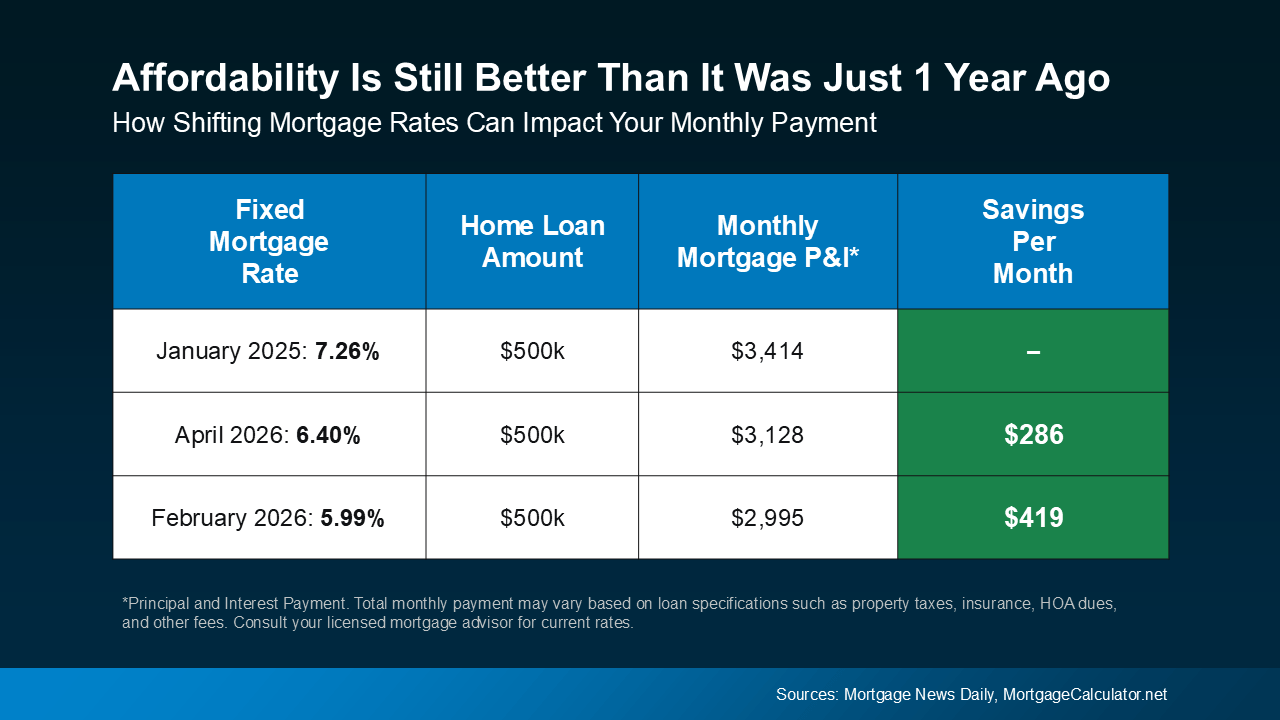
Let’s say you’re taking out a loan for $500k. Even with rates in the mid 6s, you’re still saving roughly $300 on your monthly payment compared to buyers who made their purchase early last year.

That means this recent increase in rates hasn’t erased the progress we’ve seen. Buying is still more affordable than it was just one year ago (see below):

a blue and green chart with white text

Sure, your monthly payment would’ve been a little less expensive a few weeks back. But hindsight is always 20/20.

The goal moving forward shouldn’t be to perfectly time the market. Things change too quickly for that. Instead, the real goal is to make the best decision you can based on where things are today. And the best advice anyone can give is: brace for volatility.

When It Comes To Rates, Expect the Unexpected

Mortgage rates are going to continue to be move around in the weeks or months ahead as new information and economic reports come out.

Try to remember, you can’t control global events or where rates go next week (or even next month). But you can control how you prepare. If you do that, it becomes less about the headlines, and more about your situation.

If You Want or Need To Move, You Still Can

The simple truth is, if you want or need to move, you still can.

Some buyers are choosing to move forward right now because their needs haven’t changed. A growing family, a job relocation, a lifestyle shift – those things still matter.

And for buyers who do decide to move forward, there are ways to make it work.

For example, you could explore options like adjustable-rate mortgages (ARMs) to get a lower rate upfront. That may or may not be the right fit for you, but it highlights an important point: there are strategies that can help you move, even now.

What matters most is having a plan.

And working with the right agent and lender is a big part of that. With expert help, you’ll:

  • Understand your budget and what the math looks like at today's rates.

  • Explore your financing options, including ARMs and assistance programs.

  • Have trusted guidance from experts who'll keep you up to date throughout the process.

Bottom Line

Even though there’s some uncertainty, that doesn’t mean you’re out of options.

If you need to move, you still can. Let’s connect so we can explore all your options and make your move happen.

The information contained, and the opinions expressed, in this article are not intended to be construed as investment advice. Keeping Current Matters, Inc. does not guarantee or warrant the accuracy or completeness of the information or opinions contained herein. Nothing herein should be construed as investment advice. You should always conduct your own research and due diligence and obtain professional advice before making any investment decision. Keeping Current Matters, Inc. will not be liable for any loss or damage caused by your reliance on the information or opinions contained herein.

Posted in Real Estate
April 17, 2026

Your House Hasn’t Sold Yet. Should You Rent It Out Instead?

When your house sits on the market longer than expected, it can get frustrating fast.

You start asking: what now? And for a growing number of homeowners, that turns into: should I just rent it instead?

While it sounds like a simple backup plan, becoming “accidental landlord” is actually a much bigger decision than most people realize. That’s when someone planned to sell, didn’t get the price or traction they hoped for, and decided to rent the house out instead.

And lately, that's happening more often.

Why the Number of Accidental Landlords Is Rising

If you’re faced with the same choice to rent or to sell, here’s what you need to know. First, you’re not alone. And that should actually be some comfort.

According to Zillow about 2.3% of homes available for rent were previously listed for sale. That may not sound like a lot, but it’s actually the highest share in almost 6 years.

Before you go that route yourself, it’s worth slowing down and looking at the full picture. Ask yourself these 3 questions first.

1. Would Your House Actually Work as a Rental?

What’s right for your situation is going to depend on your location, your home’s condition, and what the rental market looks like in your area. Think about:

  • If you’re moving away, do you have a plan for how you’ll handle ongoing maintenance and repairs from afar?
  • Does your house need repairs before it’s rental-ready? And do you have the time, energy, and the funds for that?
  • What's the market like in your area? Are there a lot of rental vacancies?
  • What monthly rent could you realistically expect?

As C&C Property Management explains:

“At the heart of any rental market is the balance between supply and demand. When more tenants are looking for housing than there are available units, rental prices rise. On the other hand, if new construction adds hundreds of apartments or homes to a neighborhood, prices can soften as tenants have more choices.”

If your home would struggle to stand out or command the rent you need, that’s something to take seriously. Just because you can rent it doesn’t mean it’s the best option for you.

2. Are You Ready To Be a Landlord?

This is the part people don’t always think about upfront. On paper, renting sounds like easy passive income. But in reality, it’s a hands-on responsibility. Imagine:

  • Taking midnight calls about clogged toilets or broken air conditioners
  • Chasing down missed rent payments
  • Covering unexpected repairs
  • Fixing damage between tenants

And those costs can hit when you least expect them.

3. Have You Run the Real Numbers?

There’s also the financial side of things. For starters, renting out your house comes with extra expenses. Here are a few of the biggest according to Bankrate:

  • Higher insurance premiums (landlord insurance typically costs about 25% more)
  • Management fees (if you use a property manager, they typically charge around 10% of the rent)
  • Routine maintenance and services
  • Advertising fees to find tenants
  • Gaps between tenants, where you cover the mortgage without rental income coming in

For some people, that’s totally manageable. For others, it’s more than they want to take on.

Your Next Step: A Conversation with Your Agent

Before you make any decision, talk to your current agent about overhauling your sales strategy first. Sometimes it’s not that buyers aren’t out there. It’s that something about the pricing, presentation, or marketing isn’t quite lining up with what they’re looking for.

And a few small adjustments can make a big difference.

Because while renting can be a great choice for the right person with the right house, if you’re only considering it because your listing didn’t get traction, there may be a better solution.

Bottom Line

If you're torn between selling and renting, make sure to carefully weigh the pros and cons first. For some homeowners, the hassle (and the expense) of renting may not be worth it.

The information contained, and the opinions expressed, in this article are not intended to be construed as investment advice. Keeping Current Matters, Inc. does not guarantee or warrant the accuracy or completeness of the information or opinions contained herein. Nothing herein should be construed as investment advice. You should always conduct your own research and due diligence and obtain professional advice before making any investment decision. Keeping Current Matters, Inc. will not be liable for any loss or damage caused by your reliance on the information or opinions contained herein.

Posted in Real Estate
April 14, 2026

Planning An Equestrian Property Search In Rincon Valley

Looking for a horse property in Rincon Valley can feel simple at first glance. You see acreage, desert views, and easy access to open space, and it is tempting to assume the land will work for your plans. In reality, the best equestrian search starts with a closer look at zoning, drainage, trail access, and site layout so you can focus on parcels that truly fit your goals. Let’s dive in.

Why Rincon Valley Appeals to Equestrian Buyers

Rincon Valley stands out because it offers a rural setting with strong county-level protections for its character and landscape. Pima County’s Rincon Valley special-area policy is designed to preserve scenic quality, dark night skies, riparian habitat, and views toward the Rincon Mountains and Saguaro National Park.

For equestrian buyers, that matters because the area’s identity is tied to open land, lower-intensity development, and trail connectivity. The same county policy also supports equestrian linkages and calls for a 30-foot-wide easement next to Rincon Creek for continuous hiking, biking, and equestrian trails.

Rincon Valley also sits beside Saguaro National Park’s Rincon Mountain District. The National Park Service notes that this area includes a 4,011-acre expansion with old ranch roads converted into trails, though some land remains privately owned and closed to public use. That means the outdoor lifestyle is very real here, but actual riding access still needs to be confirmed on each property.

Start With Zoning First

If you are planning an equestrian property search in Rincon Valley, zoning should be one of your first filters. Lot size alone does not tell you what you can do with the land.

Under Pima County code, the CR-1 zone allows agriculture and horticulture, and horses and similar animals may be kept on lots of at least 36,000 square feet at a density of no more than one animal per 10,000 square feet of lot area. In CR-2, the county uses that same density rule, but the minimum threshold is one commercial acre.

Those numbers are a starting point, not the whole story. A parcel may look large enough on paper, but setbacks, drainage areas, and other site limits can reduce how much land is actually usable for horses, barns, corrals, or an arena.

What zoning can affect

When you compare properties, zoning can influence:

  • How many animals the parcel can support
  • Whether existing equestrian improvements appear consistent with county standards
  • How much room you have for future barns, corrals, and turnout areas
  • Whether your long-term plans match the land’s legal use

This is one reason equestrian searches often require more than a standard home tour. You want the land to work both legally and practically.

Review Barn and Corral Requirements

If a property already has horse facilities, or you plan to add them later, county standards matter. In the animal-use section of Pima County code, stock-tight fenced areas must provide at least 400 square feet per animal.

The same code section also states that animal buildings carry a 50-foot setback from side and rear lot lines. Corrals cannot be closer than 50 feet to a neighboring residence or living quarters.

These details matter when you are judging whether a parcel can comfortably support your goals. A property might have enough acreage overall, but if the best flat area sits too close to lot lines, washes, or neighboring improvements, your ideal layout may not be realistic.

Focus on Usable Land, Not Just Acreage

One of the biggest mistakes buyers make is treating all acreage the same. In Rincon Valley, site layout often matters just as much as lot size.

Pima County’s special-area policy emphasizes minimal site disturbance, protection of steep slopes, riparian restoration, and preservation of viewsheds along areas such as Camino Loma Alta and Old Spanish Trail. That makes parcels with naturally flatter terrain or previously disturbed build areas especially worth a closer look.

When you tour land, think beyond the home itself. Ask where a trailer turns around, where an arena would sit, where runoff moves during storms, and whether the property’s usable areas are grouped together or broken up by washes and grade changes.

Practical site questions to ask

As you narrow your list, it helps to evaluate each property with questions like these:

  • Where is the most usable flat ground?
  • Is there enough room for horse circulation and trailer access?
  • Are the barn, paddock, and turnout areas logically placed?
  • Do slopes or drainage channels cut off part of the site?
  • Would future improvements disturb sensitive parts of the parcel?

A beautiful lot is not always an easy equestrian lot. The goal is to find one that supports your day-to-day use without forcing costly compromises later.

Check Floodplain and Drainage Early

Drainage is a major part of planning an equestrian property search in Rincon Valley. Pima County states that floodplain use permits are required for most improvements in regulatory floodplains or erosion hazard areas, including structures, additions, fencing, walls, drainage modifications, and erosion-control measures.

The county’s flood hazard mapping is helpful, but it is general guidance only and does not guarantee that every flood or erosion hazard is shown. Because of that, Pima County encourages buyers to confirm floodplain status before purchase through its Floodplain Management resources.

This step matters even more for equestrian buyers because barns, corrals, fencing, and arenas can all be affected by drainage patterns. A parcel that looks perfect during a dry showing may present very different conditions during monsoon season.

If a home is in a federally mapped floodplain and financed with a federally backed loan, flood insurance is mandatory. Even when it is not legally required, the county recommends insurance for structures that may be impacted by flooding.

Separate Trail Access From Trail Potential

Rincon Valley has real appeal for riders who want access to the outdoors, but it is important to separate what exists today from what is planned or policy-supported. Pima County’s broader Trails Element supports a countywide multi-use network that includes equestrian connectivity and links between public and private lands.

In Rincon Valley, county policy specifically calls for trail linkage between Rocking K and Vail Valley, a paved multi-use path along Old Spanish Trail, and the continuous trail easement along Rincon Creek. These are meaningful signals when you are choosing where to search.

Still, a smart buyer verifies the details. Proximity to a trail corridor is not the same as direct legal access from your parcel.

Riding access near Saguaro National Park

The Rincon Mountain District of Saguaro National Park allows horses and pack animals on designated trails. The park prohibits off-trail riding in most areas, limits stock groups to 15 animals, and provides designated trailer parking in the Rincon Valley area about 0.4 mile south of the Loma Alta trailhead.

The park also notes that Loma Alta parking is limited and often fills on weekends. For some buyers, that makes nearby trailer access and weekday riding convenience part of the property search, not just a nice bonus.

Build a Smart Due-Diligence Checklist

A strong equestrian search is part lifestyle planning and part verification work. Listing descriptions can be helpful, but they should not be your only source for decisions about barns, arenas, access, or animal use.

Before you move forward on a property, it helps to confirm the basics with county tools and records. Pima County’s code compliance portal allows permit status searches by address, which can be useful if a seller says an existing barn, corral, or arena was properly permitted.

Your Rincon Valley equestrian checklist

Use this checklist to compare properties:

  • Confirm the exact zoning designation
  • Verify animal-density limits based on lot size
  • Check whether the parcel has recorded access or trail easements
  • Review floodplain and erosion status before closing
  • Research permit history for existing barns, corrals, arenas, and fencing
  • Evaluate usable land area, not just total acreage
  • Confirm public trail access instead of assuming it
  • Consider trailer parking, turnaround space, and daily horse logistics

This kind of review can save you time, money, and frustration. It also helps you compare properties based on function, not just appearance.

Why Local Guidance Matters

Rincon Valley horse properties are rarely one-size-fits-all. Two parcels with similar acreage can offer very different outcomes once you look at zoning, setbacks, access, drainage, and trail connections.

That is where local, property-specific guidance becomes valuable. Instead of relying on broad marketing language, you can build a shortlist around how you actually plan to use the land, whether that means keeping a few horses, improving an existing setup, or finding a site that supports a future custom build with equestrian features.

If you want help sorting through Rincon Valley acreage, equestrian homes, or lot-driven opportunities in southeast Tucson, Debbie G. Backus offers the kind of local insight that can help you move from a broad search to a realistic plan.

FAQs

What should you verify first when searching for an equestrian property in Rincon Valley?

  • Start by confirming the property’s zoning, animal-density limits, usable acreage, and floodplain status.

How many horses can a Rincon Valley property allow under Pima County rules?

  • In CR-1 and CR-2 zoning, Pima County allows horses and similar animals at a density of no more than one animal per 10,000 square feet of lot area, subject to minimum lot thresholds.

Can you assume a large lot in Rincon Valley will work for a barn or arena?

  • No. Setbacks, slopes, washes, drainage concerns, and usable flat ground can all limit where equestrian improvements can go.

Does living near Saguaro National Park guarantee riding access?

  • No. The area has strong outdoor appeal, but access must be verified parcel by parcel, and park riding is limited to designated trails.

Why is floodplain research important for Rincon Valley horse properties?

  • Floodplain status can affect where you place structures, fencing, and arenas, and it may also determine whether flood insurance is required for financed purchases.

How can you check whether an existing barn or corral was permitted in Pima County?

  • You can search permit status by address through Pima County’s code compliance resources before moving forward with a purchase.
Posted in Real Estate