Area Real Estate News & Market Trends

You’ll find our blog to be a wealth of information, covering everything from local market statistics and home values to community happenings. That’s because we care about the community and want to help you find your place in it. Please reach out if you have any questions at all. We’d love to talk with you!

Aug. 17, 2025

3 Reasons To Buy a Home Before Spring

Let’s face it — buying a home can feel like a challenge with today’s mortgage rates. You might even be thinking, “Should I just wait until spring when more homes hit the market and rates might be lower?”

But here’s the thing, no one knows for sure where mortgage rates will go from here, and waiting could mean facing more competition, higher prices, and a lot more stress.

What if buying now — before the spring rush — might actually give you the upper hand? Here are three reasons why that just might be the case.

1. Less Competition from Other Buyers

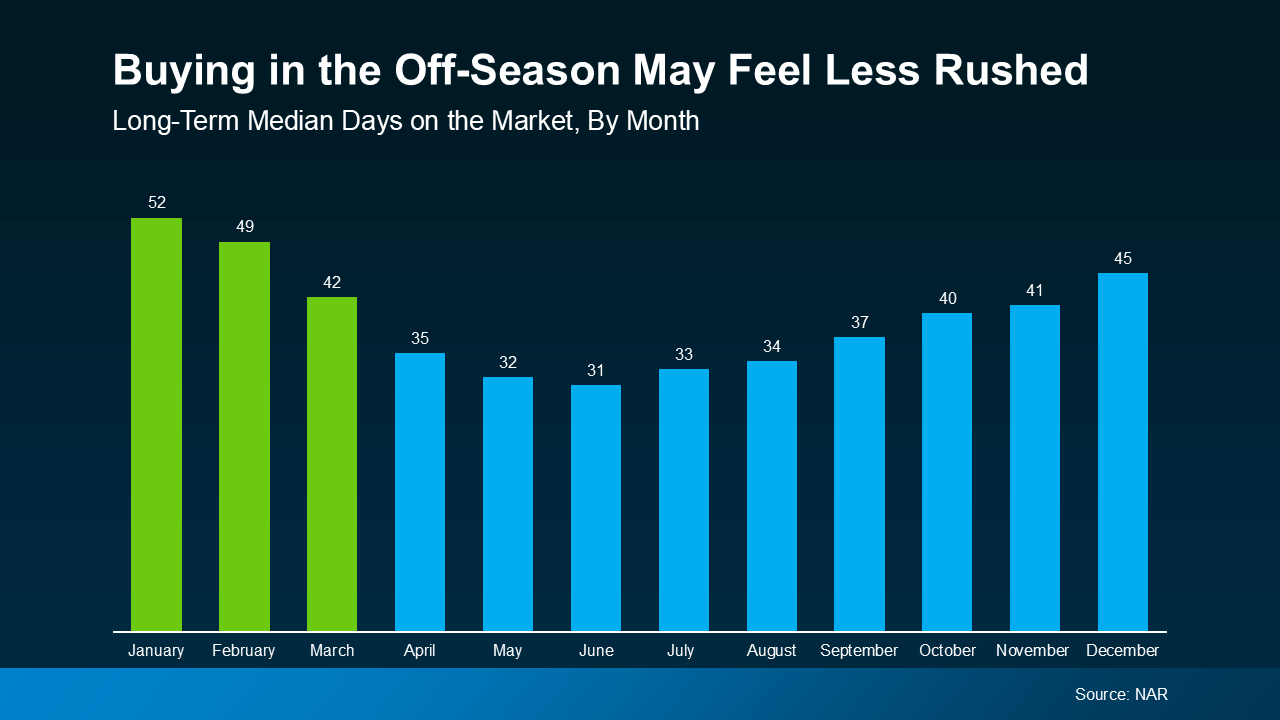
The winter months tend to be quieter in the real estate market. Fewer people are actively looking for homes, which means you’ll likely face less competition when you make an offer. This makes the process feel less rushed and less stressful.

According to the National Association of Realtors (NAR), homes sit on the market longer in winter compared to spring and summer (see graph below):
a graph of blue and green bars

Fewer buyers in the market means you’ll likely have more time to make thoughtful decisions. It also means you may have more negotiating power. According to the Alabama Association of Realtors:

A significant benefit of buying a home in winter is the reduced competition. Because of the perceived benefits of spring, many buyers delay the start of their house hunt. As a result, you will find fewer people competing for the same properties during winter. Less demand can translate into more negotiating power as sellers may be more willing to entertain offers or agree to concessions to get a deal closed quickly.”

2. More Negotiating Power

With homes staying on the market longer, sellers may be more willing to negotiate. This can lead to better deals for you as a buyer, whether that means a lower price or added incentives, like sellers covering closing costs or making repairs. As Chen Zhao, an Economist at Redfinpoints out:

“. . . buying during the off season means less competition from other buyers. That means potentially negotiating a better deal.

Plus, when demand is lower, sellers often feel more pressure to work with serious buyers. This could give you an edge to negotiate terms that work best for your situation.

3. Lock in Today’s Prices Before They Rise

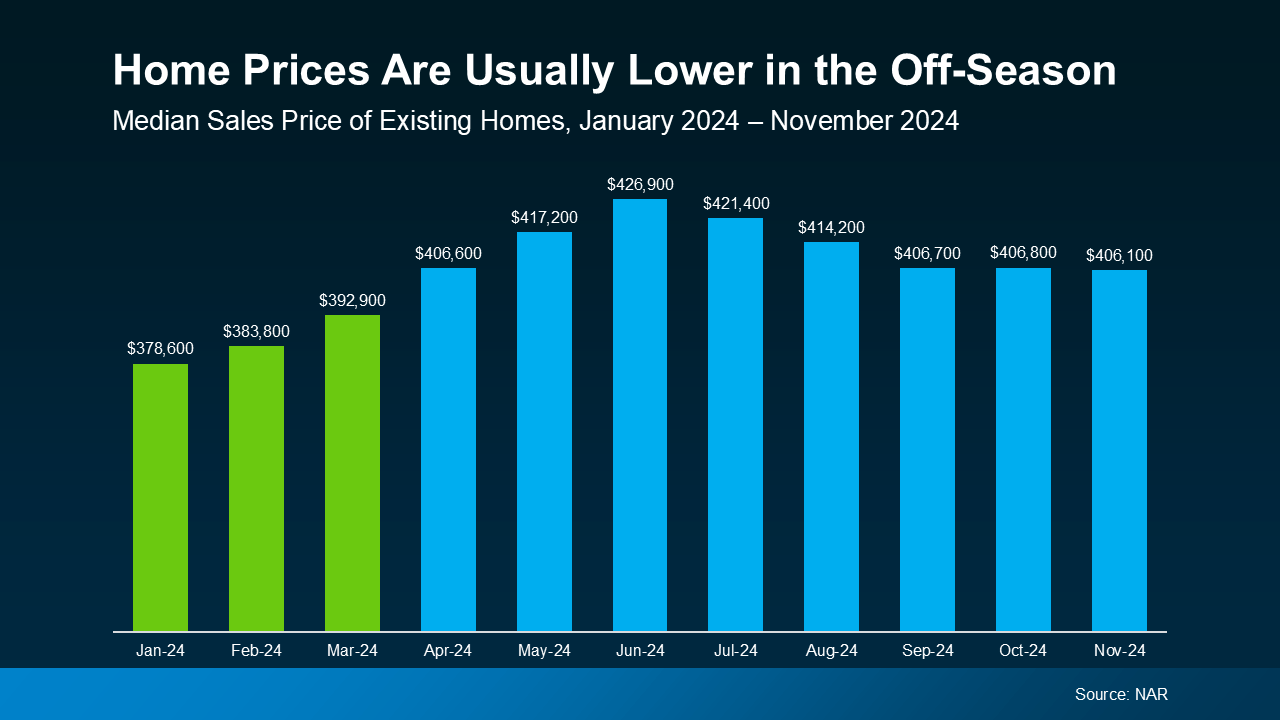
Historically, home prices tend to be at their lowest point in the winter months, too. According to data from NAR, home prices last year were at their lowest in January, February, and March — right before the spring buying season kicked in (see graph below):
a graph of prices and numbers

This trend isn’t new — Bright MLS shows between 2010 and 2024, home prices in January and February were, on average, 15% lower than during the month of peak home prices (typically June). Buying in the off-season means you’re more likely to avoid paying the premium prices that come with the high demand of spring.

On top of that, home prices generally appreciate over time, meaning they tend to go up year after year. That means if you’re ready to buy and you can make it happen, you’re not only taking advantage of what might be the lowest prices of the year, but you’re also locking in today’s price before it increases in the future.

Bottom Line

While spring may seem like the obvious time to buy, moving before the peak season can give you significant advantages, like less competition, more negotiation power, and lower prices.

If you’re ready to explore your options, let’s connect.

The information contained, and the opinions expressed, in this article are not intended to be construed as investment advice. Keeping Current Matters, Inc. does not guarantee or warrant the accuracy or completeness of the information or opinions contained herein. Nothing herein should be construed as investment advice. You should always conduct your own research and due diligence and obtain professional advice before making any investment decision. Keeping Current Matters, Inc. will not be liable for any loss or damage caused by your reliance on the information or opinions contained herein.


Posted in Real Estate
Aug. 14, 2025

When Is the Perfect Time To Move?

It’s easy to get caught up in the idea of waiting for the perfect moment to make your move – especially in today’s market. Maybe you’re holding out and hoping mortgage rates will drop, or that home prices will fall. But here’s what you need to realize: trying to time the market rarely works. And here’s why.

There is no perfect market.

No matter when you buy, there’s always some benefit and some sort of trade-off – and that’s not a bad thing. That’s just the reality of it. If you’re not sure you buy into that, think back to the last 5 years in housing.

Just a few years ago, mortgage rates hit a historic low. To take advantage of that, a ton of buyers rushed to buy a home and lock in those lower rates. The side effect? With such a big increase in how many buyers were purchasing, the homes on the market were snapped up fast. And since that resulted in so few homes left for sale, bidding wars became the norm and home prices went through the roof. Those buyers got a great rate, but they had other things to contend with.

Now, with higher rates and higher prices, it’s more expensive to buy. You can’t argue that. But at the same time, the number of homes for sale is at the highest point in several years. That means you have more options to choose from and you’ll be less likely to find yourself in a pull-out-all-the-stops bidding war. Again, there are benefits and trade-offs in any market.

So, if you have a reason to move and can afford to do so, you’ve got to take advantage of the trends that work in your favor and lean on a pro to help you navigate the rest. As Bankrate says:

“The complexities of the current conditions mean that, now more than ever, it’s smart to lean on the guidance of an experienced local real estate agent. If you want to enter the housing market in 2025, whether as a buyer or a seller, let a pro lead the way for you.”

While achieving your goals may feel like an uphill battle in today’s complex market, it is doable. But you’ll need the help of a trusted real estate agent and a lender.

Your agent will help you explore creative solutions – like looking into different housing types (like smaller condos), considering homes that need a little elbow grease, or casting a wider net for your search area. And your lender will walk you through different loan options and down payment assistance programs, so you know what you need to do to make the numbers work for you. As Yahoo Finance says:

“Buying a house at a time when both mortgage rates and home prices are favorable is a challenge. You probably shouldn’t try to time the housing market . . . Buy when it makes sense for you personally.”

Bottom Line

There’s no perfect time to move – every market has its pros and cons. The key is knowing how to make the most of the factors working in your favor. If you need to move and can afford to do it, let’s connect so you’ll have the guidance and tools to make it possible. 


The information contained, and the opinions expressed, in this article are not intended to be construed as investment advice. Keeping Current Matters, Inc. does not guarantee or warrant the accuracy or completeness of the information or opinions contained herein. Nothing herein should be construed as investment advice. You should always conduct your own research and due diligence and obtain professional advice before making any investment decision. Keeping Current Matters, Inc. will not be liable for any loss or damage caused by your reliance on the information or opinions contained herein.
Posted in Real Estate
Aug. 11, 2025

Expert Forecasts for the 2025 Housing Market

Wondering what’s in store for the housing market this year? And more specifically, what it all means for you if you plan to buy or sell a home? The best way to get that information is to lean on the pros.

Experts are constantly updating and revising their forecasts, so here’s the latest on two of the biggest factors expected to shape the year ahead: mortgage rates and home prices.

Will Mortgage Rates Come Down?

Everyone’s keeping an eye on mortgage rates and waiting for them to come down. So, the question is really: how far and how fast? The good news is they’re projected to ease a bit in 2025. But that doesn’t mean you should expect to see a return of 3-4% mortgage rates. As Lawrence Yun, Chief Economist at the National Association of Realtors (NAR), says:

 “Are we going to go back to 4%? Per my forecast, unfortunately, we will not. It’s more likely that we’ll go back to 6%.”

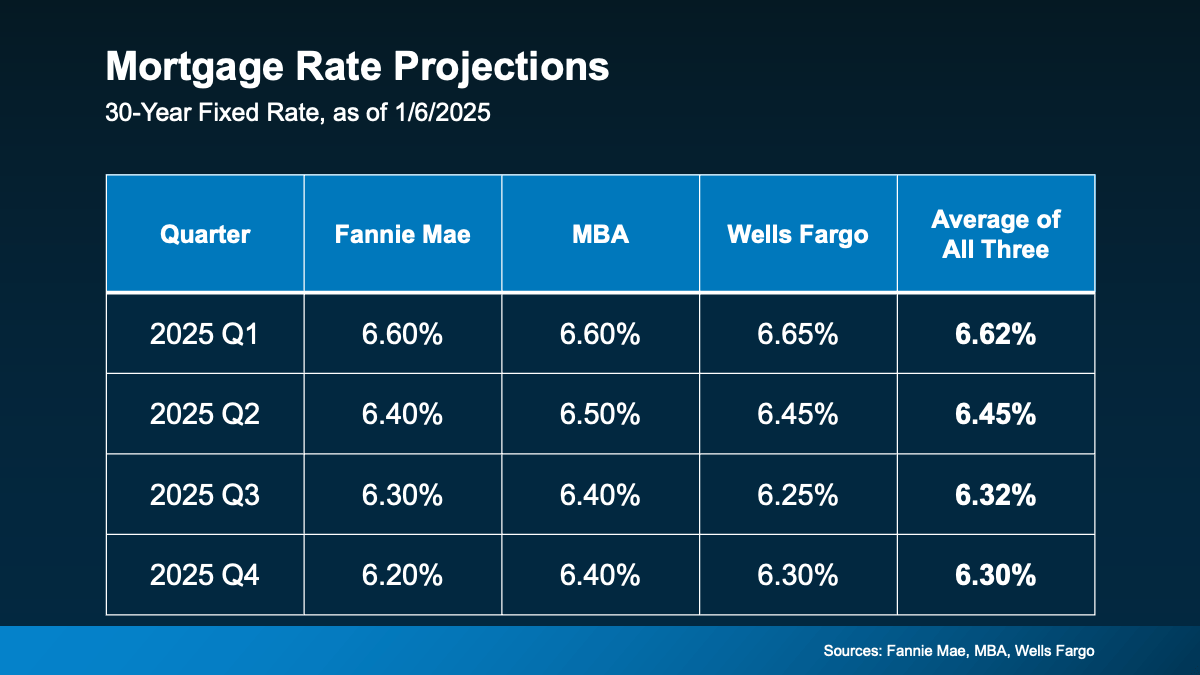
And the other experts agree. They’re forecasting rates could settle in the mid-to-low 6% range by the end of the year (see chart below):

a blue and white graph with numbers and text

But you should remember, this will continue to change as new information becomes available. Expert forecasts are based on what they know right now. And since everything from inflation to economic drivers have an impact on where rates go from here, some ups and downs are still very likely. So, don’t get caught up in the exact numbers here and try to time the market. Instead, focus on the overall trend and on what you can actually control.

A trusted lender and an agent partner will make sure you’ve always got the latest data and the context on what it really means for you and your bottom line. With their help, you’ll see even a small decline can help bring down your future mortgage payment.


Will Home Prices Fall?

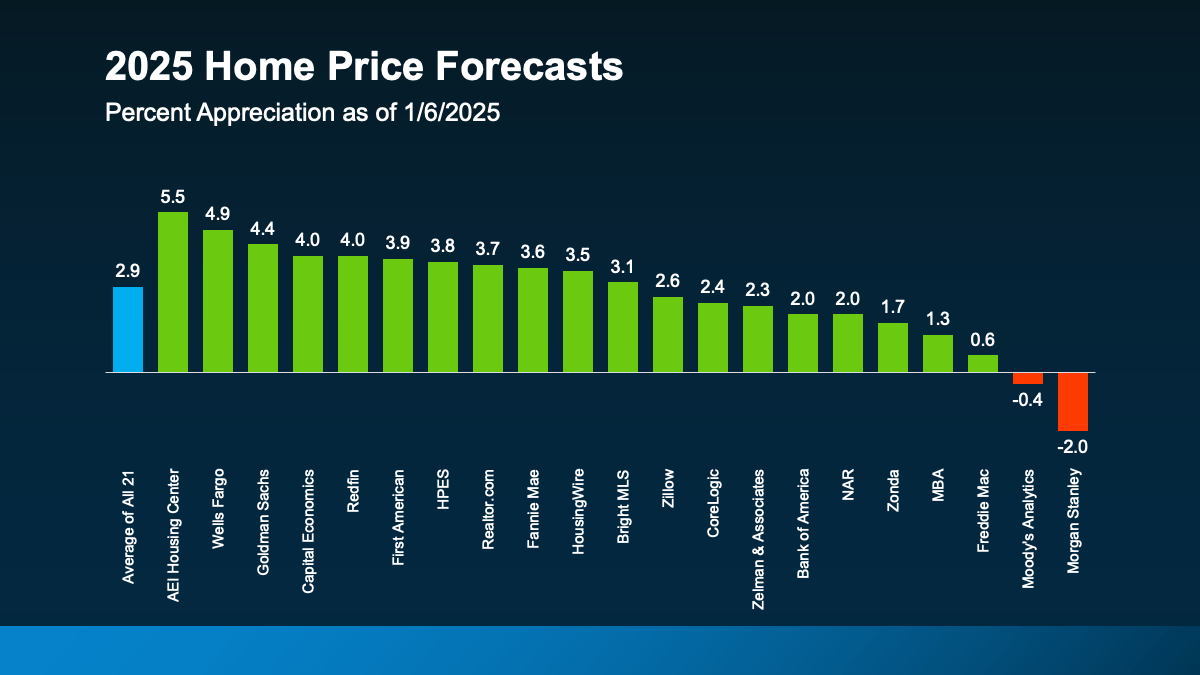
The short answer? Not likely. While mortgage rates are expected to ease, home prices are projected to keep climbing in most areas – just at a slower, more normal pace. If you average the expert forecasts together, you’ll see prices are expected to go up roughly 3% next year, with most of them hitting somewhere in the 3 to 4% range. And that’s a much more typical and sustainable rise in prices (see graph below):

a graph of green and white text

So don’t expect a sudden drop that’ll score you a big deal if you’re thinking of buying this year. While that may sound disappointing if you’re hoping prices will come down, refocus on this. It means you won’t have to deal with the steep increases we saw in recent years, and you’ll also likely see any home you do buy go up in value after you get the keys in hand. And that’s actually a good thing. 

And if you’re wondering how it’s even possible prices are still rising, here’s your answer. It all comes down to supply and demand. Even though there are more homes for sale now than there were a year ago, it’s still not enough to keep up with all the buyers out there. As Redfin explains:

“Prices will rise at a pace similar to that of the second half of 2024 because we don’t expect there to be enough new inventory to meet demand.”

Keep in mind, though, the housing market is hyper-local. So, this will vary by area. Some markets will see even higher prices. And some may see prices level off or even dip a little if inventory is up in that area. In most places though, prices will continue to rise (as they usually do).

If you want to find out what’s happening where you live, you need to lean on an agent who can explain the latest trends and what they mean for your plans.


Bottom Line

The housing market is always shifting, and 2025 will be no different. With rates likely to ease a bit and prices rising at a more normal and sustainable pace, it’s all about staying informed and making a plan that works for you.

Let’s connect so you can get the scoop on what’s happening in our area and advice on how to make your next move a smart one.


The information contained, and the opinions expressed, in this article are not intended to be construed as investment advice. Keeping Current Matters, Inc. does not guarantee or warrant the accuracy or completeness of the information or opinions contained herein. Nothing herein should be construed as investment advice. You should always conduct your own research and due diligence and obtain professional advice before making any investment decision. Keeping Current Matters, Inc. will not be liable for any loss or damage caused by your reliance on the information or opinions contained herein.


Posted in Real Estate
Aug. 8, 2025

How to Explain Real Estate Compensation to Clients

Talking about money is complicated and sometimes stressful. Talking about the complexities of your real estate compensation can be even more difficult. Check out this animation for an easy approach to explaining how you get paid. Share widely and use with clients who might want the visual guide. The National Association of REALTORS® also encourages the use of buyer representation agreements to reinforce expectations for agents’ pay and services.

Here are some key points you should remind clients about how you’re compensated:

  • Compensation is always negotiable. At the start of the homebuying process or at any point before the transaction closes, buyers and sellers have the option to negotiate compensation.
  • Costs are spelled out to buyers and sellers. As part of the written listing agreement, sellers decide what fee they are willing to pay for their agent’s services and how much of that fee goes to the real estate agent who finds the buyer. Buyer’s agents tell their clients how much of their compensation comes from the total proceeds of the sale. At closing, both sellers and buyers are reminded how much each agent is being paid and by whom.
  • Agents only get paid if the home sells. Listing agents are typically paid from the proceeds of the sale. Then, they pay the buyer agent’s compensation. This payment model is crucial to ease the cost of purchasing a home and help more Americans access homeownership, especially for first-time buyers.
  • There are no standard commissions or service offerings. Compensation varies based on service, consumer preference and the free market. But compensation can also fluctuate. You should also consider that there are different types of agents with varying commission structures and levels.


Source : https://www.nar.realtor/magazine/real-estate-news/sales-marketing/video-how-to-explain-real-estate-compensation-to-clients

Posted in Real Estate
Aug. 5, 2025

What’s Next for Home Prices and Mortgage Rates?

If you’re thinking of making a move this year, there are two housing market factors that are probably on your mind: home prices and mortgage rates. You’re wondering what’s going to happen next. And if it’s worth it to move now, or better to wait it out.

The only thing you can really do is make the best decision you can based on the latest information available. So, here’s what experts are saying about both prices and rates.

1. What’s Next for Home Prices?

One reliable place you can turn to for information on home price forecasts is the Home Price Expectations Survey from Fannie Mae – a survey of over one hundred economists, real estate experts, and investment and market strategists.

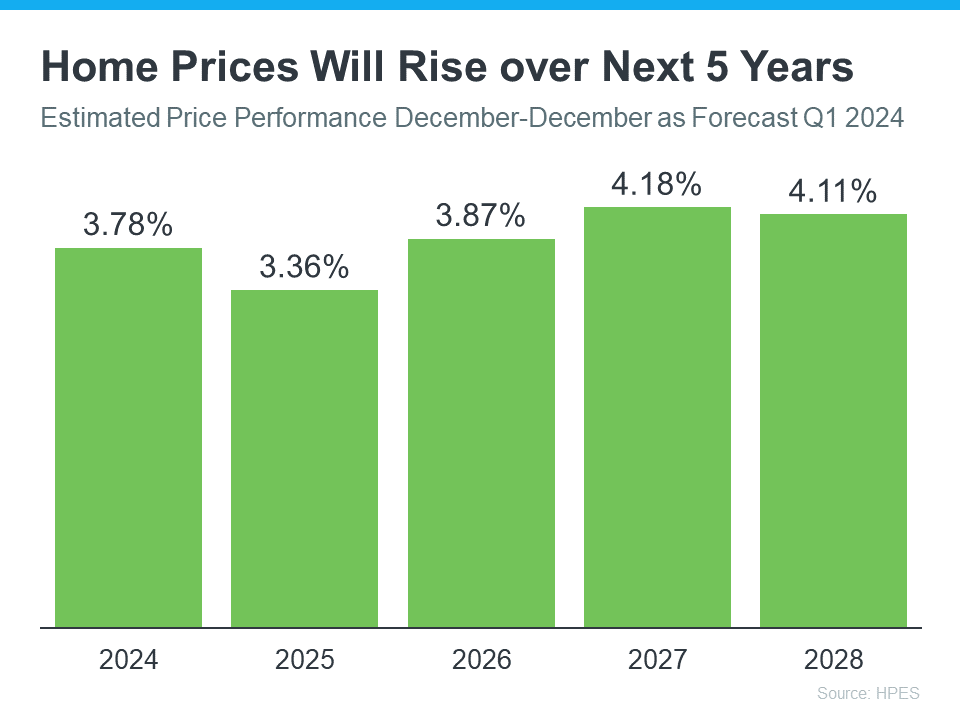
According to the most recent release, experts are projecting home prices will continue to rise at least through 2028 (see the graph below):

No Caption Received


While the percent of appreciation varies year-to-year, this survey says we’ll see prices rise (not fall) for at least the next 5 years, and at a much more normal pace.

What does that mean for your move? If you buy now, your home will likely grow in value and you should gain equity in the years ahead. But, based on these forecasts, if you wait and prices continue to climb, the price of a home will only be higher later on. 

2. When Will Mortgage Rates Come Down?

This is the million-dollar question in the industry. And there’s no easy way to answer it. That’s because there are a number of factors that are contributing to the volatile mortgage rate environment we’re in. Odeta Kushi, Deputy Chief Economist at First American, explains:

“Every month brings a new set of inflation and labor data that can influence the direction of mortgage rates. Ongoing inflation deceleration, a slowing economy and even geopolitical uncertainty can contribute to lower mortgage rates. On the other hand, data that signals upside risk to inflation may result in higher rates.”

What happens next will depend on where each of those factors goes from here. Experts are optimistic rates should still come down later this year, but acknowledge changing economic indicators will continue to have an impact. As a CNET article says:

“Though mortgage rates could still go down later in the year, housing market predictions change regularly in response to economic data, geopolitical events and more.”

So, if you’re ready, willing, and able to afford a home right now, partner with a trusted real estate advisor to weigh your options and decide what’s right for you. 

Bottom Line

Let’s connect to make sure you have the latest information available on home prices and mortgage rate expectations. Together we’ll go over what the experts are saying so you can make an informed decision on your move.

The information contained, and the opinions expressed, in this article are not intended to be construed as investment advice. Keeping Current Matters, Inc. does not guarantee or warrant the accuracy or completeness of the information or opinions contained herein. Nothing herein should be construed as investment advice. You should always conduct your own research and due diligence and obtain professional advice before making any investment decision. Keeping Current Matters, Inc. will not be liable for any loss or damage caused by your reliance on the information or opinions contained herein.

Posted in Real Estate
Aug. 2, 2025

What’s Really Happening with Mortgage Rates?

Are you feeling a bit unsure about what’s really happening with mortgage rates? That might be because you’ve heard someone say they’re coming down. But then you read somewhere else that they’re up again. And that may leave you scratching your head and wondering what’s true.

The simplest answer is: that what you read or hear will vary based on the time frame they’re looking at. Here’s some information that can help clear up the confusion.

Mortgage Rates Are Volatile by Nature

Mortgage rates don’t move in a straight line. There are too many factors at play for that to happen. Instead, rates bounce around because they’re impacted by things like economic conditions, decisions from the Federal Reserve, and so much more. That means they might be up one day and down the next depending on what’s going on in the economy and the world as a whole.

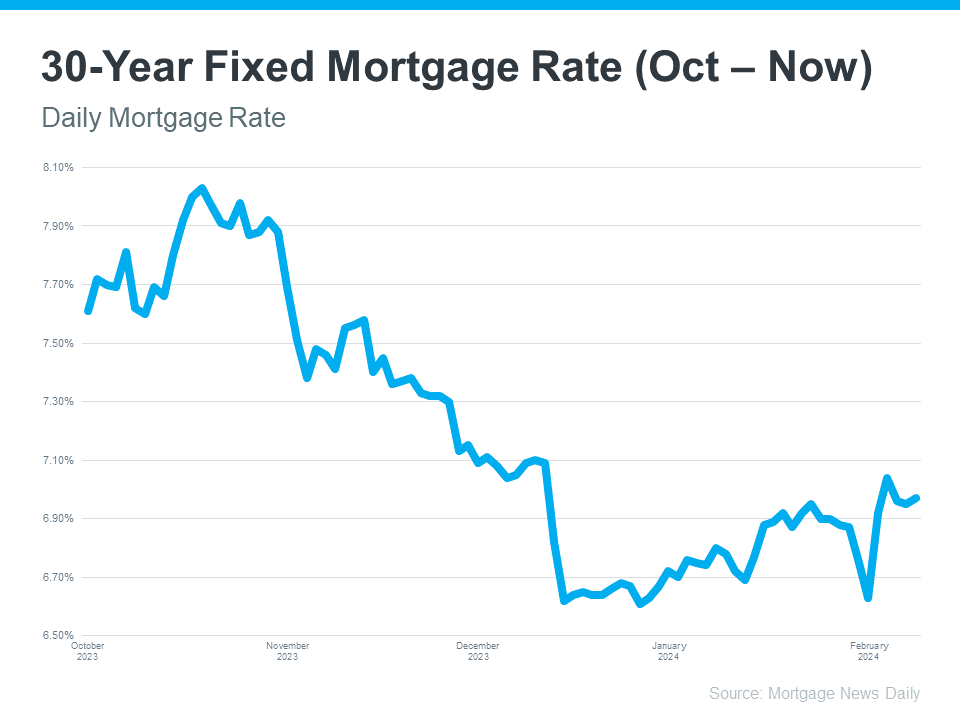
Take a look at the graph below. It uses data from Mortgage News Daily to show the ebbs and flows in the 30-year fixed mortgage rate since last October:

If you look at the graph, you’ll see a lot of peaks and valleys – some bigger than others. And when you use data like this to explain what’s happening, the story can be different based on which two points in the graph you’re comparing.

For example, if you’re only looking at the beginning of this month through now, you may think mortgage rates are on the way back up. But, if you look at the latest data point and compare it to the peak in October, rates have trended down. So, what’s the right way to look at it?

The Big Picture

Mortgage rates are always going to bounce around. It’s just how they work. So, you shouldn’t focus too much on the small, daily changes. Instead, to really understand the overall trend, zoom out and look at the big picture.

When you look at the highest point (October) compared to where rates are now, you can see they’ve come down compared to last year. And if you’re looking to buy a home, this is big news. Don’t let the little blips distract you. The experts agree, overall, that the larger downward trend could continue this year

Bottom Line

Let’s connect if you have any questions about what you’re reading or hearing about the housing market.

Posted in Real Estate
July 30, 2025

7940 S Trail Rider Place S, Vail, AZ 85641 Now Has a New Price of $170,000!


LAND

  • 7940 S Trail Rider Place S
  • Vail, AZ 85641
  • Listed by: Backus Realty And Development, (520) 403-2574
  • 109,336Sq Ft
1 of 15 magnificent lots ranging from 1.99 acres to approx. 4.53 acres. All are nestled in the newest phase of Coyote Creek with outstanding views, great hiking and biking trails, close proximity to the recreation center which includes pickleball and tennis courts, a basketball court, a children's playground, and a BBQ area. Members of the community can board their horses at the equestrian center for a cost of $425 a month per horse which includes AM & PM feeding, 2-16 stall barns, stalls cleaned twice a day, 1 arena, 2 round pens, 2 feed rooms, 4 tack rooms, 4 shower stalls. Miles and miles of dedicated trails. 2 miles from the Arizona Trail and all easements have been acquired to get into Saguaro National Park. 25 minutes from major employers, 25 minutes to TIA, 30 minutes to downtown Tucson.

Posted in Real Estate
July 27, 2025

Another Property Sold - 8505 S Circle C Ranch Road, Vail, AZ 85641


SINGLE-FAMILY

  • List Price $1,025,000
  • Sold Price $1,025,000
  • 8505 S Circle C Ranch Road
  • Vail, AZ 85641
  • Listed by: Backus Realty And Development, (520) 403-2574
  • 3Beds - 2 Full 1 Half Baths - 2,985Sq Ft

Step into the open-concept great room, graced with soaring 13' ceilings, and be captivated by the awe-inspiring views that surround you. It's a space designed to inspire and delight, perfect for entertaining and making cherished memories. The gourmet kitchen is a chef's paradise, featuring 42'' cherry cabinets, stainless steel appliances, and an oversized kitchen island with a stylish breakfast bar. It's the heart of the home, where culinary creativity and gatherings come to life. The sprawling outdoor space offers endless possibilities for entrainment and leisure, making it an entertainer's paradise. Let's not forget about the Pebble Tech pool and spa in this backyard oasis with over 1500 sf of covered patio.. Imagine hosting gatherings with loved ones, sipping cocktails by the pool.

Posted in Real Estate
July 24, 2025

Understanding the Key Factors Affecting Today’s Housing Market

Whether you’re buying or selling a house, it’s important to have a basic understanding of the housing market. However, that can be a lot more complicated than it seems. Many factors affect both your local and national housing markets, some of which can be hard to track and quantify. However, there are some basics you can start with to gain a better understanding.

 
Here are the fundamental things that affect the housing market:

The Economy

The more active and strong the economy is, the better the housing market is. A strong economy means lots of people are spending money. This includes buying houses. Buyers stimulate the economy by taking up inventory and creating higher demand, which creates higher property values. During periods of economic struggle, the housing market may also suffer. The most common examples of this are properties staying on the market for a long time and decreasing property values.
 

Interest Rates

For many, a mortgage is essential to buying a home. Therefore, the interest rates offered by lenders can have a huge effect on the overall housing market. If mortgage rates are high, it can make would-be buyers hesitant to purchase. When the rates are lower, there might be much more buyer activity. Interest rates vary daily, but there are also longer-term trends buyers and sellers can follow for more insight into the overall housing market.
 

Demographics

Demographics like age, household size, and income all play a part in a local housing market. These facts affect property values in specific regions. An area with highly rated schools will attract families, for example. An area near a college campus may have a hot rental market but very little inventory for purchase. While there are many factors that determine the property values of an area, knowing the needs of your target audience is key to selling or buying in a community.
 

Buyer’s vs. Seller’s Market

Buyer’s and seller’s markets have different levels of supply and demand. For example, in a buyer’s market, there are lots of properties available with low prices and mortgage rates. A seller’s market has high demand because of a lack of inventory and therefore also has higher prices. The current amount of supply compared to the amount of demand for real estate in a certain area will affect the housing market.
 
Knowing your local housing market will help you determine the best time to buy or sell a home. While the market is complex and constantly changing, keep these factors in mind when making your next real estate decision.

Posted in Real Estate
July 18, 2025

DIY Concrete Guide: Make Your Own Box Planters

 
DIY concrete projects are a great way to increase your home improvement skills while providing meaningful concrete crafts that could help you stay organized for years to come. However, concrete DIY projects can often seem daunting, but they can be as easy as any other DIY project.
 
For example, try turning an old cardboard box into a custom DIY concrete planter for your garden. Using just a few basic materials, you can create a durable planter box while getting a second use out of an otherwise recycled item. Here is a guide to making your own DIY concrete planter box:
 

DIY concrete planter tools and supplies

  • 2 Cardboard boxes (one large for the outside of the planter, one smaller box for the inside)
  • Duct tape
  • Cardboard corner protector inserts
  • Concrete mix
  • Mixing bucket
  • Plastic wrap or sheet
  • Safety mask & gloves
 

How to make your planter

  1. Since cardboard isn’t watertight, you’ll need to reinforce it with duct tape to create a solid concrete mold. Cover the inside of the large box with duct tape and use the protector inserts in the corners. This will help the box keep its shape under pressure.
  2. Cover the outside of the smaller box with duct tape, taking care to completely cover the corners and edges.
  3. Mix the concrete in your bucket by adding the dry material and water. For the correct amount of water, follow the specific instructions included with the concrete. Stir the mixture until it’s smooth, adding more water as necessary.
  4. Fill the larger box about halfway with the concrete mixture.
  5. Press the smaller box into the concrete mixture. Add something heavy to the box, like rocks or sand, to help maintain pressure.
  6. Carefully add more concrete to the sides around the small box until it reaches the top edge of the large box.
  7. Cover the entire box with plastic and allow it to cure for several days in a temperate environment. The curing time for your specific mixture may vary, so consult the instructions for details.
  8. Once the concrete has fully cured, it’s time to remove the boxes. Tear or cut the cardboard down each corner to pull away the sides. It’s optional to remove the inner box but recommended to help avoid mildew from outdoor use.
  9. With the outer box removed, you’re free to sand away sharp edges if you wish. You might also consider using a concrete sealer.
Now you have your own custom-made DIY concrete planter for your porch or garden. You can repeat this same process with any size or shape of a cardboard box. Try adding concrete stain or paint for extra customization to match your personal garden decor.

Posted in Real Estate